Bodenxt: A Complete Guide to Boden’s Green Transition, Growth, Jobs, Housing, and Future
Bodenxt is a major development platform connected to the Municipality of Boden in northern Sweden. It represents the municipality’s effort to manage one of the biggest periods of economic, industrial, environmental, and social change in its modern history.
The name may look like a technology product or a private company, but Bodenxt is better understood as a framework for community development. It brings together several areas that must grow at the same time, including skills, housing, business development, infrastructure, sustainability, and the wider needs of a growing population.
The reason Bodenxt has attracted attention is closely connected to the rapid green industrial development taking place in Boden. Stegra’s large green steel project has become an important accelerator for this transformation. The municipality says that the coming development represents a leap comparable to roughly 20 years of development.
This makes Bodenxt interesting far beyond Sweden. What happens in Boden can offer useful lessons for other communities that are trying to welcome large clean-energy investments while also protecting quality of life, expanding housing, developing infrastructure, and preparing local workers for new jobs.
In simple terms, Bodenxt is about making sure that industrial growth becomes community growth.
This article explains what Bodenxt means, why it was created, how it is connected to green steel and hydrogen, what opportunities it creates, what challenges Boden faces, and what its development could mean in the years ahead.
What Is Bodenxt?
Bodenxt is the Municipality of Boden’s platform for managing and supporting the community-wide green transition taking place in Boden.
The municipality describes Bodenxt as a platform for the major green transition of the entire society in Boden. Stegra’s establishment is identified as an important accelerator, but the idea is broader than one company or one industrial project.
That distinction is important.
Bodenxt is not simply another name for the Stegra steel plant. It is not a steel company, a hydrogen producer, or a private investment fund. Instead, it is connected to the municipality’s wider work to prepare Boden for rapid change.

The transformation includes several connected areas:
- Skills and workforce development
- Housing and living conditions
- Business development
- Infrastructure
- Green industry
- Education and training
- Community services
- Sustainable urban development
- Local economic growth
- Integration of new residents and international talent
The basic idea is easy to understand. A major industrial investment can create thousands of jobs, but jobs alone do not create a successful community.
Also read:Seekde: A Complete Guide to the AI-Powered Discovery and Learning Platform
Workers need homes.
Families need schools.
Businesses need infrastructure.
Companies need skilled employees.
Residents need transportation, healthcare, recreation, public services, and safe neighborhoods.
The municipality therefore needs to develop many parts of society at the same time.
That is where Bodenxt becomes important.
Why Is Bodenxt Important?
Boden is experiencing an unusually fast period of transformation.
For many years, like several smaller northern communities, Boden faced demographic challenges. Today, the situation is changing because of industrial investment, new employment opportunities, the expansion of the Swedish Armed Forces, and growing interest from people and companies outside the region.
The Municipality of Boden reported that its population reached 28,624 at the end of 2025, which was 376 people higher than its forecast. The municipality also reported that 2,067 people moved to Boden during 2025, compared with 1,516 in 2024.
This growth is important because population change affects almost everything.
More residents can support:
- Local shops
- Restaurants
- Schools
- Transportation
- Housing development
- Cultural activities
- Sports
- Public services
- Small businesses
- Local investment
However, rapid growth also creates pressure.
More people require more homes, roads, water systems, wastewater treatment, schools, childcare, public transportation, and other services.
This is why Bodenxt should be viewed as a community-management strategy rather than simply a green-industry initiative.
The Connection Between Bodenxt and Stegra
One of the biggest reasons behind Boden’s current transformation is Stegra’s green steel project.
Stegra, formerly known as H2 Green Steel, is developing a large green steel production facility in Boden Industrial Park. The project is designed around the use of hydrogen and renewable electricity to significantly reduce the carbon emissions associated with traditional steel production.
The project has received international attention because steelmaking is one of the industries that is difficult to decarbonize.
Traditional steel production commonly depends on coal-based processes. The green steel approach seeks to replace fossil-fuel-intensive steps with hydrogen produced using electricity.
Stegra’s Boden project is therefore closely connected to the broader clean-energy transition.
The Municipality of Boden identifies Stegra’s establishment as an important accelerator for the municipality’s wider transformation.
But Bodenxt goes beyond Stegra.
A successful green industrial ecosystem needs suppliers, engineers, construction workers, logistics companies, service providers, technology businesses, educators, housing developers, and many other organizations.
That means one major industrial project can create a much wider economic network.
How Green Steel Can Change a Local Economy
Steel may seem like a highly specialized industry, but its economic impact can extend into many other sectors.
Imagine a large industrial facility being constructed in a relatively small municipality.
The facility needs construction services.
Construction companies need workers.
Workers need accommodation.
Accommodation requires property development.
New residents need groceries, restaurants, transportation, healthcare, schools, recreation, and other services.
Businesses serving the industrial project may also need offices, warehouses, equipment, maintenance services, software, engineering support, and logistics.
This creates a chain reaction.
Bodenxt can therefore be understood as an attempt to manage this chain reaction instead of allowing different parts of the community to develop separately.
This is one of the most important lessons from Boden’s experience.
A green industrial transition is not only about reducing emissions. It is also about building the social and economic systems needed to support the transition.
Bodenxt and the Green Transition
The term green transition is often used to describe the movement away from fossil-fuel-based systems toward cleaner energy, lower emissions, resource efficiency, and more sustainable production.
In Boden, the concept has a particularly industrial meaning.
The municipality is positioning itself as a location where renewable electricity, green hydrogen, industry, innovation, and sustainable development can work together.
Boden has access to significant renewable electricity resources in northern Sweden. This creates an important advantage for industries that require large amounts of electricity.
Hydrogen is another major part of the story.
The Municipality of Boden describes the area as a potential green hydrogen hub for the northern Nordic region. The municipality highlights the combination of renewable electricity and Stegra’s hydrogen production plans as important factors behind this opportunity.
This could help create an industrial ecosystem where energy-intensive businesses can operate with lower carbon emissions.
What Makes Boden Different?
Boden has several characteristics that make it attractive for green industry.
First, it is located in northern Sweden, a region with strong renewable energy resources.
Second, it has an established industrial and infrastructure base.
Third, Boden has a long history as a military and garrison community.
Fourth, the municipality is actively planning for population and business growth.
Fifth, the region has access to international transportation connections and nearby cities such as Luleå.
The combination is important.
Green industry requires more than inexpensive electricity. Companies also need land, transportation, workers, education, communications, utilities, suppliers, and predictable planning.
Boden’s development strategy attempts to bring these factors together.
The Main Areas Covered by Bodenxt
The Municipality of Boden says it created five sub-projects to manage and enable the transformation. The areas highlighted by the municipality include skills supply, living and housing, business development, and infrastructure above and below ground.
These areas can be understood as interconnected pieces of one larger system.
Skills Supply
Green industries require specialized workers.
These can include engineers, electricians, technicians, machine operators, construction workers, project managers, environmental specialists, logistics professionals, and many other roles.
A local community cannot rely entirely on importing workers forever.
That is why skills development is an important part of Bodenxt.
Boden has been working with education and workforce initiatives to prepare people for future employment opportunities. The municipality launched an engineering program in January 2026 in response to emerging jobs connected to industry and defence.
This is a practical example of how industrial development can influence education.
The goal is not simply to attract companies. The goal is also to give local people a realistic path into the new economy.
Living and Housing
Housing is one of the biggest challenges facing Boden.
Population growth sounds positive, but fast growth can become a problem if homes are not built quickly enough.
The Municipality of Boden reported in May 2026 that the vacancy rate for rental apartments was close to zero. It also said that housing shortages were making it harder for people to move to Boden and for businesses to recruit workers.
This is one of the clearest examples of why Bodenxt needs to cover the entire community.
A company can create a new job, but if the employee cannot find a home, the job may not lead to permanent population growth.
Housing therefore becomes part of economic policy.
The municipality currently has detailed development plans that together could enable around 1,300 apartments and 500 detached houses. However, construction is being slowed by high costs, financing conditions, and difficulties making large projects financially viable.
Business Development
A successful green transition should benefit more than one large corporation.
Local companies can benefit by supplying goods and services to new industries.
For example, opportunities can emerge in:
- Construction
- Transportation
- Catering
- Maintenance
- Engineering
- Cleaning
- Security
- Software
- Consulting
- Equipment
- Recycling
- Energy services
- Hospitality
- Property management
The municipality is also reviewing its growth program to prepare for the next phase of development.
In May 2026, Boden said its growth program was being updated for the 2027–2030 period because the municipality is now in a different economic position. The review is taking place alongside continued green industrial development and the expansion of the Swedish Armed Forces.
This shows that Bodenxt is not a fixed plan.
It must evolve as conditions change.
Infrastructure
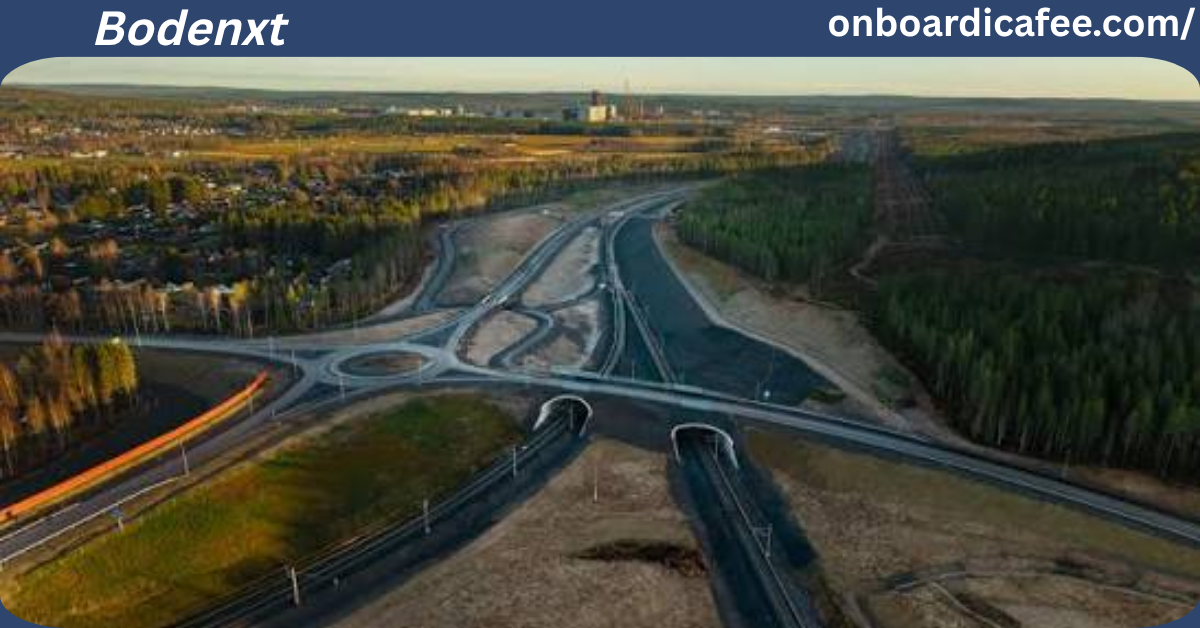
Infrastructure is the physical foundation of economic growth.
A growing industrial community needs roads, railways, electricity networks, water systems, wastewater treatment, communications, housing, public transportation, and other services.
The pressure on infrastructure can become significant when a community grows quickly.
For example, the Municipality of Boden has been investing in wastewater infrastructure because the existing system is under increasing pressure from growth.
This is easy to overlook when people discuss green steel.
A green factory still needs water.
Workers still need roads.
Homes still need sewage systems.
Businesses still need electricity and internet access.
The environmental transition therefore depends on traditional infrastructure as well as new technology.
Bodenxt and Housing: One of the Biggest Challenges
Housing deserves special attention because it may become one of the strongest limits on Boden’s growth.
The municipality has already identified a serious shortage.
According to its May 2026 update, several thousand people may need to settle in Boden because of industrial, defence, and related business growth. The shortage affects not only new residents but also people who already live in the municipality.
This creates an important economic lesson.
Growth is not automatically beneficial.
Growth must be managed.
If housing becomes too expensive or difficult to find, workers may choose to live elsewhere. That can increase commuting, put pressure on transportation systems, and reduce the local economic benefits of new employment.
Housing also affects families.
A new worker may be willing to relocate alone, but a permanent move is more likely when the whole family can find suitable housing, schools, childcare, and community services.
For this reason, Bodenxt’s housing work may be just as important as its industrial strategy.
Population Growth in Boden
The population numbers provide a useful way to understand the scale of change.
At the end of 2025, Boden had 28,624 registered residents, according to the municipality. The figure was higher than the municipality’s forecast.
The municipality also reported that many additional people were temporarily present because of industrial construction work.
This distinction is important.
A construction worker who stays in a temporary accommodation for several months contributes to local demand, but may not appear in the official population statistics.
That means traditional population figures may not always show the full economic pressure created by rapid industrial construction.
Boden must therefore plan for both permanent residents and temporary workers.
International Talent and Bodenxt
Another important part of the transformation is international recruitment.
Large industrial projects often require specialized skills that may not be available locally.
Boden has already attracted workers and professionals from different countries.
The municipality has highlighted stories of international workers who moved to Boden because of opportunities connected to the green industrial transition.
This can bring major advantages.
International workers can introduce:
- New technical knowledge
- International business experience
- Different professional networks
- New ideas
- Cultural diversity
- New consumer demand
- Global connections
But international recruitment also creates responsibilities.
People moving from another country may need help understanding local systems, finding housing, connecting with schools, building social networks, and finding opportunities for accompanying family members.
The municipality has therefore highlighted networks and opportunities for accompanying partners as part of its response to growing relocation activity.
Why Education Matters to Bodenxt
Education is one of the most powerful long-term tools in a community transition.
Industrial investment can create jobs today, but education helps prepare people for jobs tomorrow.
Boden is developing new educational and training opportunities connected to future employment needs.
This includes engineering education and other initiatives connected to industry and technology.
The important point is that workforce development should not focus only on university graduates.
A modern industrial ecosystem needs people with many types of skills.
Technicians are important.
Electricians are important.
Machine operators are important.
Safety specialists are important.
IT workers are important.
Managers are important.
Researchers are important.
Construction workers are important.
Teachers are important.
Healthcare professionals are important.
Small-business owners are important.
A strong Bodenxt strategy therefore needs a broad understanding of skills.
Bodenxt and Small Businesses
Large companies often receive most of the attention when industrial projects are announced.
However, small businesses may become some of the biggest beneficiaries.
Consider a simple example.
A new industrial facility brings thousands of workers into an area.
Those workers need food.
A restaurant receives more customers.
The restaurant hires more employees.
The restaurant buys supplies from other businesses.
A local transport company receives more deliveries.
A property company manages additional accommodation.
A cleaning company receives new contracts.
A local accountant gains new business.
A technology company provides services.
This is how an industrial investment can spread through an economy.
The Municipality of Boden has already reported examples of local businesses growing alongside industrial development. One example is a local restaurant operation that expanded as opportunities connected to Boden Industrial Park increased.
This is an important part of the Bodenxt model.
The goal should not be to create an isolated industrial zone.
The goal should be to create an ecosystem.
Circular Economy Opportunities
Green industry also creates opportunities for circular business models.
A circular economy attempts to keep materials, energy, and resources useful for as long as possible.
Instead of viewing waste as something that simply needs disposal, businesses can look at waste materials, residual heat, and by-products as potential resources.
The Municipality of Boden has highlighted work exploring how waste heat, residual materials, and by-products could become new business opportunities.
Also read:888-611-6904: Who Is Calling, Why They Call, and What You Should Do
This idea could become increasingly important as Boden’s industrial ecosystem grows.
One company’s waste can potentially become another company’s input.
One company’s excess heat can potentially support another process.
Industrial by-products can sometimes become raw materials.
The result can be a more efficient local economy.
The Role of Green Hydrogen
Hydrogen is one of the central technologies associated with Boden’s green industrial ambitions.
Green hydrogen is generally produced by splitting water into hydrogen and oxygen using electricity, with the environmental benefit depending heavily on the electricity source.
When renewable electricity is used, the resulting hydrogen can have a much lower carbon footprint than hydrogen made using fossil fuels.
In Boden, green hydrogen is closely connected to Stegra’s planned steel production system.
The basic concept is that hydrogen can be used instead of coal in the process of producing iron from iron ore.
This could significantly reduce emissions from steelmaking.
The Municipality of Boden describes the area as having the potential to become a green hydrogen hub because of its renewable electricity resources and industrial development.
Why Green Steel Matters Globally
Steel is essential to modern life.
It is used in:
- Cars
- Buildings
- Bridges
- Machines
- Appliances
- Energy infrastructure
- Railways
- Industrial equipment
But traditional steelmaking can generate large amounts of carbon dioxide.
This creates a difficult problem.
The world needs steel, but it also needs to reduce greenhouse gas emissions.
Green steel technologies attempt to solve part of this problem by changing how steel is produced.
That makes projects such as Stegra’s important beyond Sweden.
If large-scale low-carbon steel production can become commercially successful, it could demonstrate that industrial decarbonization is possible without eliminating steel production.
Bodenxt Is Bigger Than Green Steel
It is tempting to define Bodenxt as a green steel development program.
That would be too narrow.
Green steel is a major driver, but Bodenxt covers the broader community transformation.
The municipality’s own material connects Bodenxt with housing, skills, business development, infrastructure, education, and community development.
This wider view is important.
A factory can be built in a few years.
A successful community takes much longer to build.
The municipality therefore needs to think about what Boden should look like after the initial industrial construction period.
That includes questions such as:
How many people should live in Boden?
Where should new homes be built?
How should transportation work?
What skills will employers need?
How can local businesses grow?
How can new residents become part of the community?
How can natural areas be protected?
How should public services expand?
How can economic growth remain sustainable?
These are the deeper questions behind Bodenxt.
Environmental Sustainability Beyond Industry
A green transition should not focus only on industrial emissions.
Land use, water, biodiversity, transportation, food systems, waste, and urban planning also matter.
Boden is working on projects involving wetlands and nature conservation.
The municipality has also highlighted local food preparedness, sustainable agriculture, resource efficiency, and other initiatives as part of its broader development.
This wider approach is valuable.
A community cannot be considered sustainable simply because a factory uses renewable electricity.
True sustainability requires attention to the entire system.
Food and Local Resilience
Rapid population growth can expose weaknesses in local supply systems.
Food is one example.
Boden has been working on local food preparedness and established a local food preparedness council in 2026.
This is relevant to Bodenxt because resilient communities need more than jobs and infrastructure.
They also need reliable access to essential goods.
Local food production can provide environmental, economic, and resilience benefits.
The municipality has also highlighted innovative food production, including the use of surplus heat and alternative cultivation methods.
This demonstrates how industrial development can potentially connect with agriculture and food production.
The Defence Sector and Bodenxt
Green industry is not the only major force shaping Boden.
The Swedish Armed Forces are also expanding their presence.
The Municipality of Boden identifies defence growth as another important driver of population and economic development.
This creates both opportunities and additional planning requirements.
Defence-related jobs can strengthen the local economy.
At the same time, military activities can affect transportation, land use, infrastructure, emergency preparedness, and public planning.
The combination of defence growth and green industry makes Boden’s transformation particularly complex.
What Are the Main Benefits of Bodenxt?
The potential benefits are broad.
More Employment
New industrial and supporting businesses can create jobs for local residents and new arrivals.
Stronger Local Businesses
Small and medium-sized companies can gain new customers and contracts.
Better Skills
Education and training programs can prepare people for modern industrial and technical careers.
Population Growth
More employment can encourage people to move to Boden.
Greater International Visibility
Successful green industrial development can increase Boden’s profile among companies, investors, researchers, and workers.
Cleaner Industrial Production
Green steel and hydrogen technologies could contribute to lower industrial emissions.
New Infrastructure
Industrial investment can support improvements in roads, railways, utilities, water systems, and other infrastructure.
New Community Services
Population growth can support stronger retail, restaurants, cultural activities, recreation, and other services.
The Risks and Challenges of Bodenxt
A credible discussion of Bodenxt must also consider the risks.
Green transition projects are not automatically successful.
Large industrial developments can face:
- Construction delays
- Financing challenges
- Higher costs
- Skills shortages
- Housing shortages
- Infrastructure pressure
- Energy-market uncertainty
- Technology risks
- Environmental concerns
- Labour-market competition
- Population pressure
Boden is already experiencing some of these challenges.
The housing shortage is one of the clearest examples.
The municipality has said that construction is being slowed by high costs and financing conditions even though demand is strong.
This creates a difficult situation.
People want to move to Boden.
Companies need workers.
But workers need homes.
Developers want to build.
But construction costs and financing can make projects difficult.
Solving this problem requires cooperation between municipalities, developers, banks, regional authorities, businesses, and potentially national government.
Why Housing Could Determine the Success of Bodenxt
Housing may sound less exciting than hydrogen or green steel.
In practical terms, however, housing may be just as important.
If Boden cannot accommodate new workers, population growth can slow.
If population growth slows, businesses may find recruitment harder.
If businesses cannot recruit, industrial expansion may face constraints.
This creates a feedback loop.
That is why housing should not be treated as a secondary issue.
It is core economic infrastructure.
The municipality has already said that approximately 1,300 apartments and 500 detached houses are enabled through existing detailed development plans, but actual construction needs to accelerate.
The challenge is therefore not simply finding land.
It is creating financially viable housing projects at the speed required.
A More Human Side of Bodenxt
Large infrastructure projects are usually discussed using numbers.
Billions of euros.
Thousands of workers.
Millions of tonnes of steel.
Megawatts of electricity.
Tons of hydrogen.
But the real impact is experienced by people.
A family moving to Boden wants a comfortable home.
A young person wants a first job.
A student wants useful education.
A local shop owner wants more customers.
An engineer wants a good career.
A parent wants a good school.
An older resident wants suitable housing.
A new international resident wants to feel welcome.
These everyday experiences are ultimately what determine whether a development project becomes a successful community transformation.
This is why the human side of Bodenxt deserves as much attention as its industrial side.
What Can Other Cities Learn From Bodenxt?
Boden’s experience offers several lessons for communities around the world.
The first lesson is that industrial investment should be planned as a community project.
The second lesson is that housing must be planned early.
The third lesson is that education should be connected to future employment needs.
The fourth lesson is that local businesses should be included in the development process.
The fifth lesson is that infrastructure must grow before demand becomes a crisis.
The sixth lesson is that sustainability should include the entire community, not only the industrial facility.
The seventh lesson is that international talent needs integration support.
The eighth lesson is that local government needs flexibility because major projects rarely develop exactly according to the original timeline.
These lessons make Bodenxt relevant outside Sweden.
Bodenxt and the Future of Northern Sweden
Northern Sweden has become an important center of European green industrial development.
The region has renewable energy resources, industrial experience, mineral resources, transportation infrastructure, and access to Nordic markets.
Boden is one part of this larger regional transformation.
Its proximity to Luleå and the wider Norrbotten region creates additional opportunities for collaboration.
The long-term opportunity is therefore not simply to create one successful industrial facility.
It is to develop a connected regional ecosystem.
Such an ecosystem could include steel, hydrogen, mining, energy, transportation, engineering, recycling, technology, construction, research, and education.
Bodenxt can be viewed as one local response to this much larger transformation.
Is Bodenxt a Company?
No.
Bodenxt is associated with the Municipality of Boden’s community and development work.
It should not be confused with Stegra, which is the private company developing the green steel project in Boden.
This distinction is important for people searching for “bodenxt” online because the term can appear alongside information about Stegra, green steel, hydrogen, housing, jobs, and infrastructure.
Bodenxt is best understood as a municipal development platform and framework.
Is Bodenxt a Software Platform?
There is no evidence from the Municipality of Boden that Bodenxt is a conventional software platform.
The term platform is used in the context of community transformation and municipal development.
Therefore, searches for Bodenxt should not automatically be interpreted as searches for software, artificial intelligence tools, or an online business application.
The official municipal description focuses on societal transformation, skills, housing, business, and infrastructure.
Who Is Bodenxt For?
Bodenxt is relevant to many groups.
Local residents can follow it to understand how their community is changing.
Also read:Xuebaotou: Meaning, Study Culture, Features, Benefits, and the Future of Student Learning
Businesses can use the information to identify economic opportunities.
Job seekers can learn about future employment areas.
Students can explore new education and career paths.
Housing developers can understand demand.
Investors and companies can learn about Boden’s economic direction.
Researchers can study the effects of green industrial development.
Government organizations can learn from Boden’s planning experience.
International workers and families can better understand why Boden is attracting new residents.
How to Follow Bodenxt Developments
The best source for current Bodenxt information is the Municipality of Boden’s official website.
The municipality regularly publishes updates about housing, business development, infrastructure, skills, Stegra, population growth, and community development.
For the most accurate information, readers should prioritize official municipal announcements when checking current project developments.
Independent reporting can also be useful for understanding financial, industrial, political, or international perspectives.
Using both official and independent sources is generally better than relying on social media posts or unverified summaries.
What Could Bodenxt Look Like in the Future?
The future of Bodenxt will depend on several factors.
The first is whether major industrial investments continue according to plan.
The second is whether housing construction can accelerate.
The third is whether enough skilled workers can be trained and recruited.
The fourth is whether infrastructure can keep pace with growth.
The fifth is whether local companies can capture a meaningful share of new economic activity.
The sixth is whether Boden can maintain quality of life while growing rapidly.
The seventh is whether green industrial projects can achieve their environmental and commercial goals.
If these pieces come together, Boden could become an important example of how a relatively small community can participate in a major industrial transformation.
If some pieces fall behind, the growth process could become more difficult.
That is why Bodenxt should be seen as an ongoing process rather than a finished project.
Our Analysis: The Most Important Part of Bodenxt
The most interesting aspect of Bodenxt is not any individual factory.
It is the idea of synchronizing different forms of development.
Industrial development normally happens faster than community development.
A company can decide to invest billions and begin construction quickly.
A municipality cannot build a new neighborhood overnight.
A school takes time to plan.
A wastewater plant takes time to design.
Training a skilled workforce takes years.
Changing a transportation network can take even longer.
Bodenxt attempts to close this timing gap.
That may ultimately become its most valuable contribution.
The platform recognizes that industrial transformation creates secondary effects that must be planned for before they become problems.
This is a lesson that other cities can use.
Bodenxt and Sustainable Urban Growth
Sustainable urban growth means more than building new houses.
New neighborhoods need access to services and transportation.
People need safe walking and cycling routes.
Public spaces need to be attractive.
Green areas need protection.
Schools and childcare facilities need to be accessible.
The Municipality of Boden’s comprehensive planning work includes priorities such as safer walking routes, green spaces, public meeting places, activity areas, parks, and improved connections within the community.
These details matter because quality of life can influence whether workers choose to stay.
A city that attracts workers but fails to create a good living environment may struggle to retain them.
The Economic Meaning of Bodenxt
From an economic perspective, Bodenxt can be viewed as an attempt to convert external investment into long-term local value.
That value can come from:
- New jobs
- Higher local spending
- New companies
- More tax revenue
- Better infrastructure
- New skills
- Technology transfer
- Business partnerships
- Population growth
- International connections
However, economic benefits are not automatic.
A local economy captures more value when local companies and residents have the skills and capacity to participate.
This is why business development and skills supply are such important parts of the Bodenxt framework.
Why Local Participation Matters
Local participation is important for Bodenxt because the success of Boden’s growth depends on the people and businesses already living and working in the community. When local residents, small businesses, workers, schools, and organizations are involved, they can share their needs, ideas, and experience. Local businesses can also benefit by providing services and products to new industries. This can help create more jobs, support the local economy, and keep more of the benefits of development within the community. By including local people in the process, Boden can make its green transition more balanced, practical, and useful for everyone.
The Importance of Long-Term Planning
Long-term planning is very important for Bodenxt because Boden is growing quickly. New industries can bring more jobs, workers, and businesses, but the community also needs enough homes, schools, roads, transportation, and public services. Planning ahead helps Boden prepare for these changes instead of trying to solve problems after they happen. The goal is to make sure that industrial growth also creates a safe, comfortable, and sustainable place for people to live and work. Good planning can help Boden manage future growth, support local businesses, protect the environment, and provide better opportunities for residents for many years.
Frequently Asked Questions About Bodenxt
What exactly is Bodenxt?
Bodenxt is a platform used by the Municipality of Boden to coordinate and communicate its major societal transformation linked to green industry, population growth, business development, housing, skills, and infrastructure.
Is Bodenxt a private company?
No. Bodenxt is associated with the Municipality of Boden’s community development work. It is not the same organization as Stegra.
What is the main purpose of Bodenxt?
Its main purpose is to help manage Boden’s rapid transformation and create conditions for sustainable, long-term community growth.
Why is Stegra connected to Bodenxt?
Stegra’s green steel establishment is one of the major accelerators of Boden’s transformation. The municipality therefore includes Stegra-related development within its broader Bodenxt work.
Is Bodenxt only about green steel?
No. Green steel is an important driver, but Bodenxt also covers housing, workforce skills, infrastructure, business development, education, and wider community planning.
Why is housing such a major issue in Boden?
Rapid industrial and economic growth is increasing demand for homes. The municipality reported in May 2026 that the vacancy rate for rental apartments was close to zero.
Final Thoughts on Bodenxt
Bodenxt represents a major step in Boden’s transformation into a growing, sustainable, and future-focused community. While green steel and hydrogen are important parts of this change, Bodenxt is much broader. It brings together housing, jobs, education, infrastructure, business development, sustainability, and community planning.
The success of Bodenxt will depend on how well these areas develop together. New industries can create valuable jobs and attract investment, but long-term success also requires enough homes, skilled workers, reliable infrastructure, strong local businesses, and a high quality of life.
What makes Bodenxt especially important is its focus on connecting industrial growth with the needs of everyday people. If Boden can manage its rapid growth while protecting its environment and supporting residents, the community could become an important example of how green industrial development can create lasting economic and social value.
For now, Bodenxt remains an evolving journey. Its progress will be worth watching as Boden continues to build a greener economy, welcome new residents, develop local opportunities, and prepare for the future.