Masgonzola: What It Is, How It Tastes, How It Is Made, and How to Use It
Masgonzola is a name that can be confusing at first. It sounds very close to Gorgonzola, and many online descriptions use the two names almost interchangeably. But there is an important distinction: Gorgonzola is a formally protected Italian cheese, while Masgonzola is generally used for a creamy combination or style involving mascarpone and Gorgonzola rather than a separate protected cheese category.
That distinction makes Masgonzola especially interesting.
At its simplest, Masgonzola can be understood as the meeting point between two very different Italian cheeses. Mascarpone brings a rich, smooth, buttery character, while Gorgonzola contributes the blue-veined appearance, savory flavor, and gentle or pronounced tang that people associate with blue cheese. Commercial products using the name or the closely related description “Gorgonzola e Mascarpone” can be layered or combined, so the exact appearance and texture can vary.
This matters because some online articles describe Masgonzola as though it were an ancient, independently regulated Italian cheese with its own fixed production rules. That claim should be treated carefully. Gorgonzola itself has official Protected Designation of Origin status in the European Union, with defined production requirements. Masgonzola does not have the same independently protected status in the sources reviewed for this guide.
For an American reader searching for Masgonzola, the most useful question is therefore not simply “What is this cheese?” but “What does the name mean, what should I expect when I buy it, and how can I use it?”
This complete guide answers those questions in simple language while also explaining the difference between Masgonzola-style products and authentic Gorgonzola PDO.
What Is Masgonzola?
Masgonzola is generally understood as a creamy cheese combination made with mascarpone and Gorgonzola.
The name itself strongly suggests the combination:
Mascarpone + Gorgonzola = Masgonzola.
In practical terms, this creates a product with two contrasting qualities. Mascarpone is soft, rich, and mild, while Gorgonzola is blue-veined and more flavorful. Bringing them together can produce a cheese that is creamy, rich, slightly tangy, and easier for some people to enjoy than a strongly aged blue cheese.

Some products are made by blending the cheeses, while others are presented in visible layers. Retail and food references describe products containing both mascarpone and Gorgonzola, including versions using approximately equal portions of the two.
This is one reason the term Masgonzola can be confusing.
Also read:Fontlu: A Complete Guide to Modern Typography, Font Discovery, and Creative Design
There is not necessarily one single formula that every producer must follow. The product can vary according to the amount of Gorgonzola, the type of Gorgonzola used, the amount of mascarpone, and the way the two components are combined.
So if you see Masgonzola in a recipe or cheese discussion, it is sensible to check the product description rather than assuming that every Masgonzola product is identical.
Is Masgonzola a Real Cheese?
Yes and no, depending on what someone means by “real cheese.”
Masgonzola can refer to an actual food product combining mascarpone and Gorgonzola. Products of this type are commercially made and used in recipes.
However, Masgonzola should not automatically be described as a separate protected cheese variety equivalent to Gorgonzola, Roquefort, or Stilton.
Gorgonzola has a formal PDO designation. European Union documentation defines Gorgonzola as a blue-veined cheese made from pasteurized whole cow’s milk and sets specifications for its characteristics and production.
The Gorgonzola protection is significant because it means the name is connected to specific production rules and geographic requirements.
Masgonzola is different.
The most accurate way to describe it is as a cheese combination or specialty based on mascarpone and Gorgonzola.
That may sound less mysterious, but it actually makes the product easier to understand.
Masgonzola vs. Gorgonzola: What Is the Difference?
The easiest way to understand the difference is to look at their identity.
Gorgonzola is an established Italian blue-veined cheese with PDO protection.
Masgonzola is generally a mascarpone-Gorgonzola combination or style.
| Feature | Masgonzola | Gorgonzola |
| Basic identity | Mascarpone and Gorgonzola combination | Italian blue-veined cheese |
| Protected PDO name | Not established as a separate PDO in the sources reviewed | Yes |
| Main character | Creamy, rich, mild to tangy | Blue-veined, creamy, mild to strong |
| Texture | Usually very soft and spreadable | Soft to firmer depending on type and maturation |
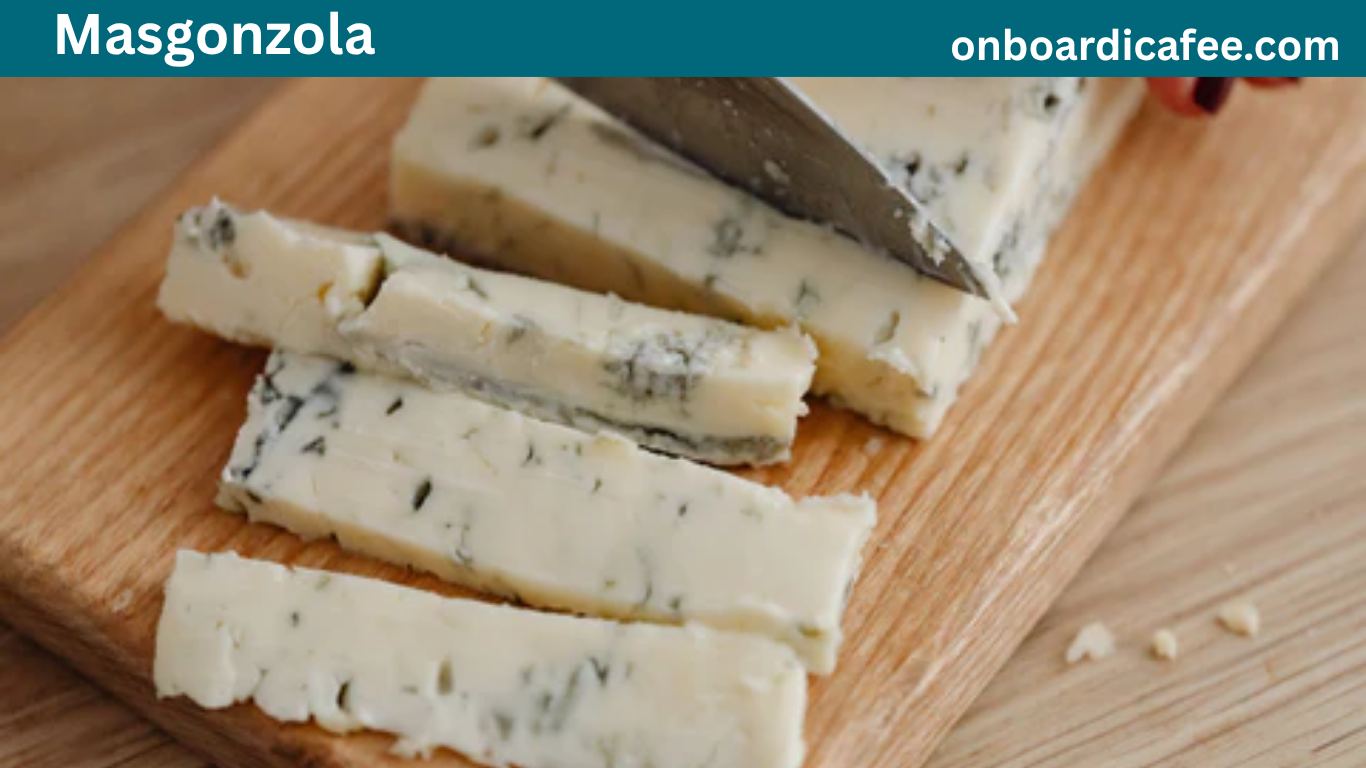
| Appearance | May show white mascarpone and blue cheese layers | White or pale yellow paste with blue-green or gray-blue veins |
| Typical use | Spreads, sauces, pasta, appetizers | Cheese boards, pasta, sauces, risotto, cooking |
| Flavor balance | Creaminess softens the blue-cheese character | More directly expresses the Gorgonzola profile |
The official European specification describes Gorgonzola as a blue-veined cheese with characteristic blue-green or gray-blue veins. It also recognizes different maturation and flavor categories.
This is why calling every blue-veined creamy cheese “Masgonzola” can create confusion.
Why Masgonzola Looks Like Gorgonzola
The visual connection is easy to understand.
Gorgonzola is famous for its blue-green or gray-blue marbling. The color comes from mold development during cheesemaking and maturation. Official specifications describe the characteristic marbling as part of the identity of Gorgonzola PDO.
When Gorgonzola is combined with mascarpone, the finished product can retain the blue-veined appearance while gaining large areas of creamy white cheese.
Depending on the production method, you may see:
- Blue-green veins
- Pale cream sections
- White mascarpone layers
- Soft marbling
- A smooth creamy surface
- A layered interior
This gives Masgonzola a distinctive appearance.
It can look like a traditional blue cheese at first glance, but the creamy sections make it visually different from a standard Gorgonzola wheel.
What Does Masgonzola Taste Like?
The taste of Masgonzola depends on the particular product, but the basic idea is easy to understand.
Mascarpone contributes richness and a mild dairy flavor.
Gorgonzola contributes tang, saltiness, savory depth, and blue-cheese character.
Together, they can create a flavor that is rich without being overwhelmingly sharp.
This is particularly appealing to people who are curious about blue cheese but do not enjoy extremely strong varieties.
The first sensation may be creamy and buttery. As the cheese remains on the palate, the Gorgonzola character becomes more noticeable.
You may experience flavors described as:
- Creamy
- Milky
- Buttery
- Tangy
- Savory
- Earthy
- Slightly sweet
- Salty
- Mildly pungent
The balance changes from product to product.
A version containing more Gorgonzola may taste stronger. A version containing more mascarpone may taste softer and richer.
That is why the product label is important when shopping.
Is Masgonzola Strong or Mild?
Masgonzola is usually better thought of as a creamy blue-cheese experience rather than a single fixed level of intensity.
Compared with a very strong blue cheese, a mascarpone-rich version may seem gentle.
Compared with plain mascarpone, however, the Gorgonzola component creates a clear savory and tangy character.
This makes it useful for people who want some blue-cheese flavor without making it the only flavor in the dish.
It can also be useful in cooking because the creamy base helps the cheese melt into sauces.
The Texture of Masgonzola
Texture is one of the biggest reasons this cheese combination is interesting.
Mascarpone is known for its very soft and creamy texture. Gorgonzola can range from soft and creamy to more crumbly depending on its type and maturation.
When they are combined, the result can become highly spreadable.
A Masgonzola-style product may feel:
- Smooth
- Soft
- Creamy
- Rich
- Spreadable
- Slightly crumbly in blue-cheese sections
Layered versions can have more than one texture in a single bite.
This makes Masgonzola particularly useful for bread, crackers, crostini, sauces, and recipes where a cheese needs to melt or blend easily.
How Is Masgonzola Made?
There is no single protected production specification for Masgonzola comparable to the official Gorgonzola PDO specification.
That means production can vary.
One approach combines mascarpone and Gorgonzola into a creamy product.
Another approach uses visible layers.
Some commercial descriptions identify products made from roughly equal proportions of Gorgonzola and mascarpone. Other specialty products use alternating layers of the two cheeses.
The general process can therefore be understood in four broad stages.
Making the Mascarpone Component
Mascarpone is a very rich Italian dairy product with a smooth and creamy texture.
Its role in Masgonzola is to soften the stronger character of the blue cheese.
Preparing the Gorgonzola
Gorgonzola is a blue-veined cheese made under specific rules when sold as Gorgonzola PDO. The official specification identifies pasteurized whole cow’s milk as the raw material and describes the characteristic blue-green or gray-blue marbling.
Combining the Two
The mascarpone and Gorgonzola can be combined or layered.
This is where a Masgonzola-style product gets its distinctive balance.
Packaging and Storage
Because both components are soft dairy products, refrigeration is important.
The exact storage period depends on the specific commercial product, packaging, and manufacturer’s instructions.
Why Mascarpone Changes Gorgonzola
This is perhaps the most important culinary idea behind Masgonzola.
Gorgonzola has a strong personality.
Mascarpone has a gentle personality.
Combining them changes the balance.
Imagine a strong blue cheese being softened with a rich cream base. The result does not remove the blue-cheese character completely. Instead, it spreads that flavor through a smoother and richer texture.
That makes Masgonzola particularly useful when you want complexity without an aggressive flavor.
Is Masgonzola an Italian Cheese?
The ingredients and culinary idea are strongly connected to Italian cheese traditions.
Mascarpone is an Italian dairy product, and Gorgonzola is a famous Italian PDO cheese associated with northern Italy.
However, it is more accurate to say that Masgonzola-style products are based on Italian cheeses rather than claiming that Masgonzola itself is an independently protected Italian cheese.
That distinction is important for anyone writing about the topic professionally.
The official Gorgonzola consortium describes Gorgonzola PDO as a product connected with territories in Lombardy and Piedmont and protected through a regulated production system.
The History Behind the Name Masgonzola
The history of the word is less clear than the history of Gorgonzola.
Gorgonzola has a documented and protected identity, while Masgonzola appears to be a modern name formed from the names of mascarpone and Gorgonzola.
That is why it is risky to claim that Masgonzola is a centuries-old cheese with a separate traditional history unless a specific producer provides documentation.
The safest interpretation is that the name communicates the product itself.
“Mas” points toward mascarpone.
“Gonzola” points toward Gorgonzola.
Together, the name immediately suggests a combination.
This naming approach is common in food. Blended or hybrid products often use names that help consumers understand their ingredients.
Why Is Masgonzola Becoming Interesting to Food Lovers?
The appeal is easy to understand.
Many people love blue cheese but find some varieties too strong.
Others enjoy creamy cheese but want more flavor than plain mascarpone provides.
Masgonzola offers a middle ground.
It combines:
- Richness
- Creaminess
- Blue-cheese flavor
- Spreadability
- Versatility
That makes it especially useful for modern cooking.
It can appear in a simple appetizer or become part of a sophisticated restaurant-style sauce.
How to Eat Masgonzola
One of the easiest ways to enjoy Masgonzola is to serve it simply.
Allow the cheese to come out of the refrigerator for a short period according to food-safety guidance and the product’s storage instructions.
Then serve it with bread, crackers, fruit, or nuts.
Simple foods work well because they allow the cheese to remain the main flavor.
Good choices include:
- Pears
- Apples
- Grapes
- Walnuts
- Almonds
- Crusty bread
- Crackers
- Honey
- Dried fruit
The combination of creamy, salty, tangy, and sweet flavors can create a balanced bite.
Masgonzola on a Cheese Board
A cheese board is one of the most natural places for Masgonzola.
Its creamy texture can provide contrast against harder cheeses.
For a balanced American-style cheese board, you might include:
- Masgonzola
- A mild cheddar
- A hard Italian cheese
- Fresh fruit
- Dried fruit
- Nuts
- Crackers
- Bread
- Honey or fruit preserves
The key is not to include too many very strong cheeses at once.
Masgonzola already provides a noticeable flavor.
Pairing it with milder ingredients allows its creamy character to stand out.
Masgonzola With Pears
Pear is one of the most natural partners for blue cheese.
The fruit provides sweetness and moisture, while the cheese provides salt and savory depth.
The creamy texture of Masgonzola makes the pairing even easier.
Try a small piece of pear with a little Masgonzola and a walnut.
The combination provides sweetness, creaminess, crunch, and tang in one bite.
Masgonzola With Honey
Honey can create a beautiful contrast with blue cheese.
A small amount is enough.
Too much honey can hide the cheese’s flavor.
The best approach is to drizzle lightly over Masgonzola served with bread or crackers.
This works particularly well as an appetizer.
Masgonzola in Pasta
Pasta is one of the strongest uses for Masgonzola.
The cheese can melt into a creamy sauce and provide both richness and blue-cheese flavor.
A simple approach is to combine Masgonzola with warm pasta and a small amount of pasta water.
The starch in the pasta water can help create a smoother sauce.
You can then add:
- Black pepper
- Walnuts
- Pear
- Spinach
- Mushrooms
- Roasted vegetables
Because Masgonzola is already rich, you do not necessarily need a large amount.
A little can add substantial flavor.
Masgonzola Risotto
Risotto is another excellent application.
The creamy texture of the cheese works naturally with the creamy consistency of risotto.
Masgonzola can be added near the end of cooking so its flavor remains noticeable.
Pear, walnuts, mushrooms, and roasted vegetables can all complement the cheese.
Gorgonzola itself is widely used in Italian first courses, and the Gorgonzola Consortium continues to feature risotto among its culinary applications.
Masgonzola on Pizza
Pizza can handle bold cheeses very well.
Masgonzola can be added in small pieces over a pizza before baking or used as part of a creamy topping depending on the specific product.
Good combinations include:
- Pear and walnut
- Mushroom and onion
- Potato and rosemary
- Fig and cheese
- Spinach and garlic
- Caramelized onion
The important point is balance.
Because the cheese is rich, avoid adding too many heavy ingredients.
Masgonzola With Steak
Blue cheese and steak are a familiar combination.
Masgonzola can provide a softer alternative to a very sharp blue cheese sauce.
It can be melted gently and served over steak or used in a creamy sauce.
The richness works especially well with grilled or pan-seared beef.
However, a little goes a long way.
Masgonzola With Vegetables
Cheese can make vegetables more appealing, and Masgonzola is particularly useful for roasted vegetables.
Try it with:
- Roasted Brussels sprouts
- Potatoes
- Cauliflower
- Broccoli
- Mushrooms
- Carrots
- Squash
The salty and creamy cheese can balance the natural sweetness created when vegetables are roasted.
Masgonzola in Sandwiches
A small amount can also work well in sandwiches.
Pair it with ingredients that provide freshness and texture.
Good combinations include:
- Turkey and pear
- Chicken and apple
- Roasted vegetables
- Prosciutto and fig
- Grilled mushrooms
- Caramelized onion
Because Masgonzola is soft, it can also function as a spread.
Masgonzola for Beginners Who Do Not Like Blue Cheese
This may be one of its most useful qualities.
Some people avoid blue cheese because they expect an intense smell and strong taste.
Masgonzola-style products can offer a gentler introduction because mascarpone adds richness and reduces the sharpness of the overall experience.
That does not mean every person who dislikes blue cheese will love it.
Taste is personal.
But if you want to explore blue-cheese flavors gradually, a creamy mascarpone-Gorgonzola combination can be worth trying.
Also read:Fanquer: Meaning, Uses, Possible Origins, Online Context, and What You Should Know
Masgonzola vs. Mascarpone
These two names can also cause confusion.
Mascarpone is a creamy Italian dairy product with a mild flavor.
Masgonzola is generally a combination involving mascarpone and Gorgonzola.
The difference is simple:
Mascarpone = mild and creamy.
Masgonzola = creamy plus blue-cheese flavor.
Mascarpone is commonly used in desserts and creamy dishes.
Masgonzola is more naturally suited to savory foods, although creative cooks can experiment with sweet and savory combinations.
Masgonzola vs. Blue Cheese
“Blue cheese” is a broad category.
It includes many cheeses with blue or blue-green mold development.
Gorgonzola is one specific Italian blue cheese.
Masgonzola-style products can include Gorgonzola together with mascarpone.
Therefore, Masgonzola should not be treated as a generic synonym for every blue cheese.
This distinction is especially important when shopping.
Masgonzola vs. Gorgonzola Dolce
Gorgonzola Dolce is the milder, creamier style of Gorgonzola.
Because Masgonzola often emphasizes creaminess, it may remind people of Gorgonzola Dolce.
However, the products are not identical.
Gorgonzola Dolce remains Gorgonzola under its protected specification, while a mascarpone-Gorgonzola product is a different preparation.
This is a good example of why names matter when buying cheese.
Can You Cook With Masgonzola?
Yes.
Its soft texture makes it especially useful for cooking.
It can be used in:
- Pasta
- Risotto
- Pizza
- Sauces
- Soups
- Crostini
- Sandwiches
- Vegetable dishes
- Meat sauces
When heating it, use moderate heat.
Very high heat can cause dairy fats and proteins to separate, creating a greasy or uneven texture.
Gentle melting usually produces a better result.
Can Masgonzola Be Used in Desserts?
It can be used in creative sweet-and-savory dishes, although this is less common than savory applications.
The creamy nature of mascarpone already makes it suitable for desserts.
Adding Gorgonzola changes the profile dramatically.
Small amounts can work with:
- Pear
- Fig
- Honey
- Walnuts
- Dark chocolate
- Dried fruit
This is an advanced pairing rather than an everyday dessert ingredient.
If you are experimenting, start with a very small amount.
Is Masgonzola Healthy?
Masgonzola should be viewed as an indulgent dairy food rather than a health food.
Because it combines rich dairy products, it can provide protein, fat, calcium, and other nutrients, but it can also be relatively high in calories and saturated fat depending on the specific formulation.
Nutrition varies significantly between products.
That means there is no single nutrition label that can accurately describe every Masgonzola-style product.
If you are watching calories, saturated fat, sodium, or other dietary factors, check the nutrition facts on the specific package.
This is more accurate than relying on generic internet claims.
Is Masgonzola Safe to Eat?
Food safety depends on the actual product, its ingredients, pasteurization status, handling, storage, and expiration information.
Consumers should follow the manufacturer’s instructions.
For refrigerated cheese, keep it cold and avoid leaving it at room temperature for extended periods.
If the package shows signs of spoilage, unusual discoloration outside the expected cheese characteristics, damaged packaging, or an off smell that is clearly different from the normal product, it is better not to consume it.
People with specific dietary or medical restrictions should also check the label and seek professional advice when needed.
Does Masgonzola Contain Mold?
A Gorgonzola component is a blue-veined cheese, so the blue-green or gray-blue marbling is part of the cheese’s intended character.
That is very different from accidental spoilage.
The molds associated with properly produced blue cheese are part of the cheesemaking process.
However, consumers should never assume that every unusual spot on every cheese is safe.
Always distinguish the expected appearance described by the producer from unexpected spoilage.
How to Store Masgonzola
Storage depends on the specific product.
Generally, refrigerated storage is essential.
Keep the cheese in its original packaging when practical or wrap it appropriately according to the manufacturer’s guidance.
Blue cheeses have strong aromas, so storing them in a sealed container can also help prevent their smell from spreading to other foods.
Avoid storing cheese beside foods that easily absorb odors.
Always follow the package’s use-by or best-before information.
How Long Does Masgonzola Last?
There is no universal answer.
A commercial product’s shelf life depends on its formulation, packaging, moisture level, storage temperature, and handling.
A sealed product may last considerably longer than an opened one.
Once opened, follow the manufacturer’s instructions and use your senses to assess quality.
Do not use a generic internet number as a substitute for the actual package instructions.
How to Buy Masgonzola in the United States
American shoppers may encounter the product under different names.
Search for terms such as:
- Masgonzola
- Mascarpone Gorgonzola
- Gorgonzola mascarpone
- Gorgonzola and mascarpone cheese
- Gorgonzola cream cheese
- Italian mascarpone blue cheese
Specialty cheese shops and gourmet food stores may be more likely to carry unusual Italian cheese products than ordinary supermarkets.
Online cheese retailers can also be useful.
However, always check the product description carefully.
A product described as “Gorgonzola and mascarpone” may be the type of cheese combination people mean when they use the term Masgonzola.
What Should You Check on the Label?
When buying Masgonzola, look at the ingredient list first.
Then check:
- Milk source
- Pasteurization information
- Cheese percentages
- Nutrition facts
- Allergens
- Storage instructions
- Country of origin
- Producer information
- Expiration or use-by information
This helps you understand exactly what you are buying.
Do not rely only on a product name.
How to Tell if a Product Is Authentic Gorgonzola PDO
If you specifically want Gorgonzola PDO rather than a mascarpone-Gorgonzola blend, look for the appropriate protected designation information.
The European Union formally recognizes Gorgonzola as a PDO product, and the Gorgonzola consortium provides information about producers and protection of the designation.
This is useful because the terms “Gorgonzola,” “blue cheese,” and “Masgonzola” should not be treated as interchangeable.
Why Accurate Terminology Matters
Food writing often becomes confusing when attractive descriptions are repeated without checking their origin.
Masgonzola is a good example.
Some online pages describe it as an ancient cheese. Others call it a new fusion. Others use the term as a broad name for a creamy blue cheese.
The evidence supports a more careful explanation.
Gorgonzola has a long documented history and legal protection.
Mascarpone has its own established Italian culinary identity.
Masgonzola is best understood as a combination or specialty using these ingredients rather than as a separately protected cheese category.
That interpretation gives readers useful information without inventing history.
What Makes Masgonzola Interesting?
The most interesting thing about Masgonzola is its balance.
Also read:HRMS Globex: Complete Guide to Features, Benefits, Employee Management, and HR Automation
It combines two opposite cheese personalities.
Mascarpone is soft, rich, and gentle.
Gorgonzola is savory, tangy, and blue-veined.
Together, they can create something that is both luxurious and practical.
This is why the product works particularly well in modern recipes.
It does not need to be the only ingredient.
It can support other flavors.
The Best Foods to Pair With Masgonzola
If you are trying Masgonzola for the first time, start with foods that naturally balance rich cheese.
Fruits
Pear, apple, fig, grapes, and dried apricots are excellent starting points.
Nuts
Walnuts, pecans, almonds, and hazelnuts can provide useful crunch.
Bread
Crusty bread, sourdough, crackers, and crostini provide a neutral base.
Vegetables
Roasted vegetables work especially well because their natural sweetness balances the cheese.
Meats
Steak, chicken, turkey, and cured meats can pair well with a creamy blue-cheese sauce or spread.
Sweet Ingredients
Honey, fruit preserves, and figs can create a strong sweet-savory contrast.
A Simple Masgonzola Appetizer
For an easy appetizer, use:
- Crusty bread
- Masgonzola
- Pear slices
- Walnuts
- A small amount of honey
Spread a small amount of cheese over the bread.
Add a thin slice of pear.
Top with a walnut.
Finish with a tiny drizzle of honey.
The result is simple but balanced.
You get creamy cheese, sweet fruit, crunchy nuts, and a touch of sweetness.
A Simple Masgonzola Pasta Idea
Cook your favorite pasta until just tender.
Reserve some pasta water.
In a pan over gentle heat, add Masgonzola and a small amount of pasta water.
Stir until the cheese becomes a smooth sauce.
Add the pasta.
Toss until coated.
Finish with black pepper and walnuts.
For extra freshness, add a few thin slices of pear or some lightly cooked spinach.
This is an example of why the creamy texture of Masgonzola can be useful in everyday cooking.
Common Mistakes When Using Masgonzola
One common mistake is using too much.
Because the cheese is rich, a small amount can be enough.
Another mistake is overheating it.
Gentle heat usually creates a smoother sauce.
Another mistake is pairing it with too many strong ingredients.
If you combine strong blue cheese, spicy sausage, hot peppers, garlic, heavy cream, and a large amount of salt in one dish, the cheese can disappear into the overall intensity.
Simple ingredients often work better.
Can Masgonzola Replace Gorgonzola?
Sometimes, but not always.
In sauces, pasta, risotto, and creamy dishes, Masgonzola can be a useful substitute when you want a softer and richer result.
However, the final dish may taste less sharply blue and may have a creamier texture.
If a recipe specifically depends on the stronger flavor of aged Gorgonzola, replacing it with a mascarpone-rich product will change the dish.
The substitution is therefore possible, but it is not identical.
Can Masgonzola Replace Mascarpone?
It can, but again, the result will change.
Mascarpone is mild.
Masgonzola contains a blue-cheese component.
Using Masgonzola in a dessert or neutral cream recipe will add savory and tangy notes.
For savory cooking, however, the substitution can be interesting.
Masgonzola for Cheese Lovers
Experienced cheese lovers may appreciate Masgonzola because it provides a different way to enjoy blue cheese.
It is not necessarily about intensity.
Instead, it is about texture and balance.
The combination of creamy and blue-cheese characteristics makes it useful in dishes where ordinary Gorgonzola might be too strong.
It can also make a cheese board more varied.
Masgonzola for People New to Blue Cheese
For beginners, Masgonzola can be an approachable introduction to blue-cheese flavors.
Start with a small serving.
Pair it with something sweet such as pear or honey.
Then compare it with a stronger Gorgonzola.
This makes it easier to understand how different blue-cheese styles can vary.
Why Masgonzola Works So Well in Modern Food
Modern cooking often values versatility.
Consumers want ingredients that can move between different types of meals.
Masgonzola can work as:
- A spread
- A pasta ingredient
- A pizza topping
- A sauce base
- A cheese-board item
- A sandwich filling
- A vegetable topping
- An appetizer ingredient
That flexibility gives it practical value beyond novelty.
Final Thoughts
Masgonzola is best understood as a creamy mascarpone-and-Gorgonzola cheese combination or specialty rather than as a separately protected cheese equivalent to Gorgonzola PDO. Its appeal comes from the contrast between mascarpone’s rich, smooth character and Gorgonzola’s distinctive blue-cheese flavor. While online descriptions sometimes make the term sound like an ancient or formally regulated cheese, the available evidence supports a more careful interpretation. Gorgonzola itself is officially protected as a PDO cheese, while Masgonzola-style products can vary in their composition and presentation.
For American food lovers, the real attraction is practical. Masgonzola can add creamy richness and blue-cheese depth to pasta, risotto, pizza, sandwiches, vegetables, appetizers, and cheese boards. It can also be a good choice for people who enjoy the idea of blue cheese but prefer a softer and creamier experience.
The best way to explore Masgonzola is to start with a small amount and pair it with simple foods such as pears, walnuts, crusty bread, honey, pasta, or roasted vegetables. Most importantly, check the product label so you know whether you are buying a mascarpone-Gorgonzola specialty, a specific branded product, or authentic Gorgonzola PDO.
Frequently Asked Questions About Masgonzola
What does the word Masgonzola mean?
Masgonzola is generally used to describe a combination of mascarpone and Gorgonzola. The name appears to be formed from parts of those two cheese names.
Is Masgonzola the same as Gorgonzola?
No. Gorgonzola is an established Italian blue-veined cheese with PDO protection. Masgonzola generally refers to a mascarpone-Gorgonzola combination or specialty.
Does Masgonzola taste like blue cheese?
Yes, if it contains Gorgonzola, it will normally have some blue-cheese flavor. However, the mascarpone can make the overall taste softer, richer, and creamier.
Why is Masgonzola so creamy?
The mascarpone component is responsible for much of its rich and smooth texture. Mascarpone is naturally very creamy, so combining it with Gorgonzola can produce a softer product.
Is Masgonzola good for a cheese board?
Yes. Its creamy texture and blue-cheese flavor can provide an interesting contrast to hard cheeses, fruit, nuts, crackers, and honey.
What fruit goes best with Masgonzola?
Pear is one of the best choices, but apples, figs, grapes, and dried fruits can also work well.