
Jeroen Dik: Career, JD Engineering, Automotive Tuning, Racing, and Lasting Influence
Jeroen Dik is a Dutch automotive specialist best known as the owner and founder of JD Engineering, a performance tuning company based in Lochem, Netherlands. His name has become closely connected with Volkswagen Group performance, engine tuning, ECU calibration, and motorsport.
JD Engineering’s own history states that Jeroen Dik started tuning cars in the 1990s. The company first became known for work on Volkswagen G60 models and for a Volkswagen Golf 1 16V G60 that competed successfully in sprint events. Over time, the business developed from a tuning activity into a full-time operation.
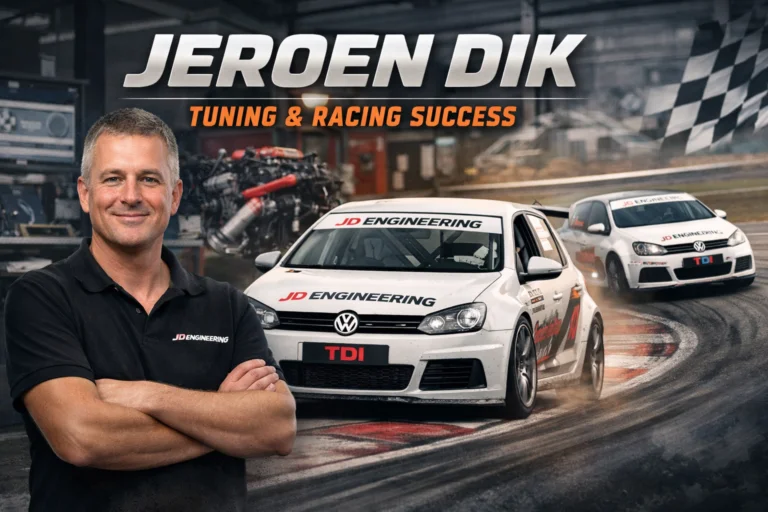
Jeroen Dik is also known for combining workshop experience with motorsport. JD Engineering records that he won the 2011 Toerwagen Diesel Cup championship after a highly consistent season in a Volkswagen Golf.
His career is interesting because it shows how automotive tuning has changed. Modern engine tuning is no longer simply about mechanical modifications or making a car produce a larger peak power number. Electronic engine management, data analysis, diagnostics, turbocharging, drivetrain behavior, emissions systems, and software calibration now play major roles.
Jeroen Dik’s professional story sits within this transition.
This article explores his career, the development of JD Engineering, his approach to Volkswagen Group vehicles, his motorsport background, the meaning of ECU tuning, notable projects, and why his work remains relevant to automotive enthusiasts.
Because some personal details about Jeroen Dik are repeated by secondary websites without strong supporting documentation, this article focuses mainly on information that can be supported by JD Engineering’s own material and established automotive publications. This is important for accuracy and helps separate documented professional achievements from claims that are difficult to verify.
Who Is Jeroen Dik?
Jeroen Dik is a Dutch automotive tuner, business owner, and racing driver associated with JD Engineering in Lochem.
His professional identity is closely connected to vehicle performance rather than mainstream celebrity. He became known within the automotive community through technical work on Volkswagen Group vehicles and through motorsport.
JD Engineering describes itself as a specialist in tuning Volkswagen, Audi, SEAT, Škoda, and Porsche vehicles. The company says it has developed extensive knowledge of the characteristics of these vehicles and uses VAG-specific diagnostic and programming equipment.
This specialization is important.
Instead of trying to work equally on every vehicle brand, JD Engineering built its reputation around a particular family of manufacturers and technologies. That allowed the company to develop detailed knowledge of different engines, transmissions, control systems, and factory configurations.
Also read:Veneajelu: The Finland’s Peaceful Boat Ride Tradition
For enthusiasts, this type of specialization can be valuable because modern vehicles are highly complex.
Jeroen Dik and the Beginning of JD Engineering
The story of Jeroen Dik and JD Engineering began during the growth of the European car-tuning scene in the 1990s.
According to the company’s own history, Dik started tuning cars during that period. His early work included Volkswagen G60 models, which became an important part of JD Engineering’s early reputation.
The G60 was an interesting platform for tuning because its supercharged engine provided opportunities for performance development. The popularity of Volkswagen performance cars also created a growing community of enthusiasts interested in modifications.
One particularly important project was a Volkswagen Golf 1 16V G60 associated with JD Engineering. The company says the car won many sprint competitions and helped JD grow rapidly.
This is an important part of understanding the company’s development.
A tuning business can advertise technical knowledge, but motorsport provides a different kind of test. Competition places pressure on engines, cooling systems, transmissions, electronics, tires, and drivers.
The lessons learned in that environment can then influence road-car development.
The Growth of JD Engineering
JD Engineering did not remain a small tuning project.
The company explains that its early success eventually turned tuning into a full-time occupation for Jeroen Dik and a small team.
This transition is significant because professional tuning requires more than mechanical skill.
A serious tuning business needs:
- Diagnostic knowledge
- Engine-management expertise
- Workshop equipment
- Testing procedures
- Customer support
- Parts knowledge
- Software development
- Quality control
- Business management
As vehicles became more electronically controlled, the technical requirements increased further.
The modern tuner has to understand both mechanical and electronic systems.
Why Volkswagen Group Vehicles Became Central to His Work
JD Engineering specializes in VAG vehicles.
VAG refers to Volkswagen Group vehicles and commonly includes brands such as Volkswagen, Audi, SEAT, Škoda, and Porsche, although individual platforms and technologies differ considerably.
JD Engineering specifically lists Volkswagen, Audi, SEAT, Škoda, and Porsche among its areas of specialization.
This specialization makes sense from a technical perspective.
Vehicles from related manufacturers often share platforms, engines, transmissions, electronics, or engineering concepts. However, they can still have important differences in calibration, cooling, weight, drivetrain layout, and intended use.
A tuner with deep experience across the group can therefore approach each vehicle with a broader technical background.
What Makes Jeroen Dik’s Approach Interesting?
One of the most interesting aspects of Jeroen Dik’s career is the connection between tuning and engineering.
Tuning is sometimes presented as a simple process:
More boost.
More fuel.
More power.
But real performance engineering is more complicated.
Increasing engine output can affect:
- Cylinder pressure
- Exhaust temperature
- Turbocharger speed
- Clutch load
- Transmission torque
- Cooling requirements
- Tire performance
- Braking demands
- Fuel requirements
- Engine longevity
This means that increasing one performance measurement can create problems somewhere else.
A good performance package therefore needs balance.
That idea appears in material about JD Engineering and its projects. A 2014 profile published through the company’s website described Dik’s philosophy as being about more than simply producing horsepower and emphasized the relationship between road and circuit experience.
Jeroen Dik and ECU Tuning
ECU tuning is one of the most important parts of modern automotive performance.
The ECU, or engine control unit, manages many aspects of engine operation.
Depending on the vehicle, it can control or influence:
- Fuel injection
- Ignition timing
- Boost pressure
- Throttle behavior
- Torque management
- Variable valve timing
- Emissions systems
- Engine protection strategies
Changing ECU calibration can therefore change how an engine behaves.
JD Engineering says that it develops chiptuning specifically for VAG engines and uses VAG-specific diagnostic and programming equipment.
The company’s approach highlights an important point: software tuning should be considered in relation to the particular engine and vehicle rather than as a generic process.
What Is Chiptuning?
Chiptuning is a common term for modifying the software calibration of an engine control system.
Older vehicles sometimes used replaceable chips, which is where the term originated. Modern vehicles generally use sophisticated electronic control units that can be programmed or recalibrated through specialized equipment.
A tuning calibration can modify parameters related to:
- Torque delivery
- Turbo boost
- Fueling
- Ignition
- Throttle response
- Torque limits
- Transmission communication
The exact changes depend on the engine and ECU.
The goal is not necessarily maximum power.
For many road cars, better drivability can be more useful than a dramatic peak power figure.
Why Torque Matters as Much as Horsepower
People often compare cars by horsepower.
However, torque is also important because it influences how strongly an engine can accelerate through different parts of its operating range.
A tuning package with a strong and usable torque curve may feel much faster in everyday driving than a setup that produces a large peak number only at a narrow engine speed.
This is one reason experienced tuners look at complete power curves rather than a single headline figure.
A well-designed calibration should consider:
- Where torque arrives
- How quickly it builds
- How long it remains available
- How the transmission handles it
- How the driver can use it
That is where engineering judgment becomes more important than marketing numbers.
The Importance of Rolling-Road Testing
JD Engineering’s website describes an in-house Superflow 4WD rolling road at its Lochem facility.
A rolling road, commonly called a dyno, allows a vehicle’s performance to be measured under controlled conditions.
This can help technicians evaluate:
- Power
- Torque
- Engine behavior
- Calibration changes
- Boost behavior
- Repeatability
Four-wheel-drive testing is particularly useful for vehicles where power is delivered to all four wheels.
Dyno testing does not replace road testing, but it provides valuable controlled measurements.
From the Road to the Racetrack
Jeroen Dik’s motorsport career adds another dimension to his technical background.
JD Engineering reports that he won the 2011 Toerwagen Diesel Cup championship. The company’s historical report states that he competed in a Volkswagen Golf 5 and consistently finished on the podium during the season.
The championship was secured during the Formido Finaleraces after Dik arrived at Circuit Park Zandvoort with a substantial points advantage.
The achievement is important because racing creates a practical environment for evaluating vehicle performance.
A race car must operate under conditions that are much more demanding than ordinary street driving.
The 2011 Toerwagen Diesel Cup Championship
The 2011 championship stands out as one of the clearest documented motorsport achievements connected with Jeroen Dik.
JD Engineering’s report explains that Dik had finished only one point short of the championship in the previous season. In 2011, he returned with the goal of winning the title.
His consistency was a major part of the result.
According to the report, he achieved at least one podium finish during each race weekend and entered the final event with a large points advantage.
This is a useful lesson in motorsport.
Championships are not always won by having the fastest car at every event. Consistency, reliability, strategy, and avoiding unnecessary mistakes can be equally important.
What Racing Can Teach a Tuner
Motorsport experience can provide lessons that are difficult to obtain from ordinary road use.
A race environment exposes weaknesses in:
- Cooling
- Braking
- Tires
- Transmission
- Engine calibration
- Fuel delivery
- Suspension
- Driver control
When a vehicle is pushed repeatedly, small problems become much easier to identify.
This creates a feedback loop.
A tuner develops a vehicle.
The vehicle is tested.
Problems become visible.
The setup is improved.
The improved system is tested again.
That cycle is fundamental to engineering development.
The Famous Volkswagen G60 Connection
The Volkswagen G60 played an important role in the early history of JD Engineering.
The G60’s supercharged engine gave performance enthusiasts an interesting platform for modification. The company’s early success with G60 models helped establish its reputation.
The Golf 1 16V G60 was especially important.
JD Engineering describes it as a legendary project that won numerous sprint competitions.
This kind of project demonstrates how an enthusiast’s interest can become a professional engineering discipline.
What begins as experimentation can eventually become a structured business when the technical results attract enough attention.
Jeroen Dik’s Role in the VAG Tuning Community
Jeroen Dik became well known among European VAG enthusiasts.
A 2012 Speedhunters feature described JD Engineering as a respected engine-tuning company and identified “JD” as referring to Jeroen Dik. The feature highlighted his reputation within the tuning community.
The importance of this reputation is not simply about popularity.
Also read:Hggbfe3fykc: What It Is, How It Works, and Why It Matters
Specialized automotive communities often share technical knowledge through:
- Forums
- Car clubs
- Events
- Magazines
- Workshops
- Racing
- Social media
- Customer experiences
A tuner who consistently produces successful builds can become an important reference point within that community.
Notable JD Engineering Projects
JD Engineering has worked on a wide range of high-performance VAG vehicles.
Its historical material includes projects involving:
- Volkswagen Golf
- Volkswagen Passat
- Audi S3
- Audi S4
- Audi RS4
- Audi R8
- Audi TT RS
- Porsche 996 Turbo
- SEAT Leon
- Škoda models
- Spyker vehicles using Audi-based engines
The company’s video archive also shows examples of tuned Audi S3, Volkswagen Golf, SEAT Leon, Audi A1, Golf R, and other models.
These projects show how broad the company’s technical experience became while remaining centered on VAG technology.
The Audi RS4 JD530 Project
One particularly interesting example is the Audi RS4 JD530.
A performance report published through JD Engineering describes the car as an S4 that Jeroen Dik purchased for developing and testing different tuning stages. After driving the car with the setup for about a year, the project had served its development purpose and was eventually offered for sale.
This illustrates an important engineering principle.
A development vehicle is not necessarily built only for show.
It can be used as a test platform.
The engineer can drive it, evaluate different configurations, identify weaknesses, and refine the final package.
That type of hands-on development can provide information that laboratory measurements alone cannot deliver.
Why Development Cars Matter
A development car allows a tuner to examine how modifications behave in real conditions.
For example, a power upgrade might look excellent on a dyno but create heat-management problems during repeated road use.
A development vehicle can reveal those problems.
Testing may include:
- Cold starts
- Hot-weather driving
- Highway use
- Repeated acceleration
- Long-distance operation
- Track sessions
- Different fuel conditions
The more complete the testing process, the more useful the final calibration can become.
Powerpack Development at JD Engineering
JD Engineering has also published information about its Powerpack systems.
Its historical website material describes Powerpack stages for VAG 2.0 TSI engines, including hardware upgrades combined with custom tuning and rolling-road calibration.
This shows the difference between software-only tuning and a more complete performance package.
A higher-output setup may require supporting hardware such as:
- Turbocharger upgrades
- Intercooler improvements
- Hardware reinforcement
- Better cooling
- Software recalibration
The exact requirements depend on the engine and target output.
Why Hardware and Software Must Work Together
Modern engines are integrated systems.
Changing the turbocharger changes airflow.
Changing airflow can change fueling requirements.
Changing fueling and boost changes thermal loads.
Changing torque can increase transmission stress.
Therefore, performance modifications should be considered as a system rather than as isolated parts.
This is one of the most useful lessons that can be taken from the work associated with Jeroen Dik and JD Engineering.
More power is not automatically better engineering.
Better engineering means making the complete vehicle work together.
The Meaning of “Balanced Performance”
Balanced performance is an important idea in automotive engineering.
Imagine two cars.
Car A produces a very high peak horsepower number but has poor cooling and an unreliable transmission.
Car B produces slightly less power but maintains stable temperatures, predictable torque delivery, and reliable operation.
For everyday driving, Car B may provide the better ownership experience.
This does not mean maximum power is unimportant.
It means performance should be evaluated in context.
A well-developed car should ideally deliver:
- Strong acceleration
- Predictable throttle response
- Stable temperatures
- Reliable operation
- Appropriate transmission behavior
- Good drivability
That broader definition of performance is particularly relevant to modern tuning.
How Automotive Tuning Has Changed
When Jeroen Dik started tuning cars in the 1990s, the industry was very different.
Mechanical modifications played a major role.
Today, electronics are central.
Modern vehicles may have:
- Multiple control units
- Networked communication
- Electronic throttle systems
- Advanced turbochargers
- Direct fuel injection
- Variable valve timing
- Complex emissions controls
- Automated transmissions
- Driver-assistance systems
This means a modern tuner needs knowledge that extends beyond traditional mechanics.
The work has become a combination of mechanical engineering, electronics, software, diagnostics, and testing.
Jeroen Dik’s Relevance in the Modern Tuning Industry
The continued relevance of Jeroen Dik comes partly from his long experience across these technological changes.
JD Engineering’s history shows a transition from early G60 tuning to modern ECU programming and VAG-specific diagnostic systems.
That evolution reflects the broader transformation of automotive engineering.
A tuner who began in the mechanical era has had to adapt to increasingly software-defined vehicles.
This is perhaps one of the most interesting parts of his professional story.
Why VAG Specialization Matters
Volkswagen Group vehicles have a large and diverse global user base.
A single group can include:
- Small hatchbacks
- Family sedans
- Performance cars
- SUVs
- Luxury vehicles
- Sports cars
This creates a large range of technical challenges.
A specialist can build knowledge around common engine families and platforms while still understanding the differences between individual vehicles.
For customers, specialization can make it easier to find a tuner familiar with a particular platform.
Jeroen Dik and Automotive Diagnostics
Performance tuning begins with understanding the vehicle’s original condition.
Diagnostics can identify:
- Fault codes
- Sensor problems
- Engine irregularities
- Boost issues
- Fuel-system problems
- Communication errors
JD Engineering specifically says it uses VAG-specific diagnostic and programming equipment.
This matters because tuning an unhealthy engine can make existing problems worse.
A responsible process therefore starts with diagnosis rather than immediately changing calibration.
Why Baseline Testing Matters
Before modifying a vehicle, technicians can establish a baseline.
This may include:
- Existing power
- Existing torque
- Boost behavior
- Engine temperatures
- Fault codes
- Fueling behavior
After modification, the same measurements can be compared.
This creates evidence of what actually changed.
Without baseline testing, it can be difficult to know whether a modification produced the expected improvement.
Jeroen Dik’s Influence Beyond Horsepower Numbers
The most important influence of a professional tuner is not necessarily a single power record.
It can be a way of thinking.
The work associated with Jeroen Dik emphasizes several useful ideas:
- Understand the platform.
- Test changes.
- Use specialized equipment.
- Consider the whole vehicle.
- Learn from motorsport.
- Develop products through real-world use.
- Focus on usable performance.
These principles remain relevant even as vehicle technology changes.
Why Motorsport and Road Tuning Complement Each Other
Road cars and race cars have different requirements.
Also read:Messagenal: A Complete Guide to Meaning, Communication, Features, Benefits, Uses, and Future
A race car can sacrifice comfort and sometimes long-term convenience for performance.
A road car needs:
- Smooth starting
- Comfortable drivability
- Reliable operation
- Emissions compliance
- Practical fuel use
- Predictable behavior
However, motorsport can reveal how components behave under extreme conditions.
The challenge for a tuner is knowing which lessons from racing can improve a road vehicle without making it impractical.
This is where engineering judgment matters.
Jeroen Dik’s Business Philosophy
A long-running specialist business needs more than technical ability.
It also needs trust.
Customers investing in performance modifications want to know that the work is based on experience and testing.
JD Engineering’s continued specialization in VAG vehicles suggests a business model built around deep technical expertise rather than trying to cover every possible vehicle type.
This is a useful lesson for technical businesses generally.
Specialization can create a stronger identity.
Instead of saying “we work on everything,” a company can become known for doing one category exceptionally well.
The Global Reach of JD Engineering
Although JD Engineering is based in Lochem, Netherlands, the company states that it has become known internationally among enthusiasts of Volkswagen, Audi, SEAT, Škoda, and Porsche.
The company also provides a dealer network, indicating that its services have extended beyond its main workshop.
This is significant because automotive tuning is now a global industry.
A specialist in one country can reach customers around the world through:
- Online communities
- Video content
- Tuning files
- Dealer networks
- Motorsport
- Automotive publications
- Social media
The internet has therefore changed how technical reputations are built.
What Enthusiasts Can Learn From Jeroen Dik
Even people who never modify a vehicle can learn useful lessons from his career.
The first lesson is specialization.
Deep knowledge in one area can be more valuable than shallow knowledge in many areas.
The second is testing.
Ideas become more useful when they are tested against real results.
The third is consistency.
The 2011 racing championship demonstrates how repeated strong results can be more important than one spectacular performance.
The fourth is adaptation.
Automotive technology changed dramatically between the 1990s and the 2020s. A professional who remains relevant must continue learning.
What Makes a Professional Tuner Different From a Hobbyist?
Many enthusiasts can install performance parts.
Professional tuning involves a larger responsibility.
A professional tuner should understand:
- Vehicle diagnostics
- Calibration
- Engine limitations
- Thermal management
- Drivetrain limits
- Testing
- Data interpretation
- Customer requirements
Experience also matters because every engine does not respond exactly the same way.
Two apparently identical vehicles can have different conditions, mileage, fuel, maintenance history, or environmental factors.
That is why proper testing is important.
The Importance of Reliability
Performance modifications can increase mechanical stress.
When output increases, components may experience higher loads.
Potentially affected systems include:
- Clutch
- Transmission
- Driveshafts
- Turbocharger
- Cooling system
- Brakes
- Tires
This is why responsible tuning should consider the complete vehicle.
A power figure without context tells only part of the story.
Jeroen Dik and the Future of Automotive Tuning
The future of tuning is changing rapidly.
Electric vehicles are becoming more common, while internal-combustion vehicles are becoming more electronically sophisticated.
Future performance work may increasingly involve:
- Software calibration
- Battery management
- Electric motor control
- Thermal management
- Advanced diagnostics
- Data analysis
- Hybrid powertrains
The basic engineering principle will remain the same.
Understand the system.
Measure the result.
Test the change.
Improve the design.
This is why the broader lessons from traditional performance tuning remain relevant even as vehicle technology evolves.
A Practical Perspective for Car Owners
If you are considering vehicle tuning, the most important question should not simply be:
“How much horsepower will I get?”
Instead, ask:
- What changes will be made?
- How will the vehicle be tested?
- What supporting hardware is required?
- How will reliability be considered?
- Is the calibration developed for my specific vehicle?
- What happens if the vehicle has an existing fault?
- Are the modifications legal for my intended use?
These questions help separate thoughtful engineering from simple marketing claims.
What the Jeroen Dik Story Really Represents
The most valuable way to understand Jeroen Dik is not simply as a person associated with a tuning company.
His career represents the evolution of automotive performance engineering.
It began in an era when mechanical tuning was central.
It developed through motorsport.
It expanded into sophisticated electronic calibration.
It eventually became part of a specialized business serving an international enthusiast community.
That progression mirrors the automotive industry itself.
Cars have become more complex, but the fundamental goal remains unchanged: make the machine perform better while understanding its limitations.
Conclusion
Jeroen Dik has built a distinctive place in the European automotive performance world through his long association with JD Engineering, his specialization in Volkswagen Group vehicles, and his experience in motorsport. JD Engineering’s own history records that Dik began tuning cars in the 1990s and that early success with Volkswagen G60 models and a Golf 1 16V G60 helped the company grow into a full-time business.
His 2011 Toerwagen Diesel Cup championship adds an important motorsport dimension to his career. The achievement was based not only on speed but also on consistency, with the team’s own account describing repeated podium finishes and a strong points advantage before the final event.
Perhaps the most useful lesson from Jeroen Dik’s career is that successful tuning is about much more than producing a large horsepower number. Modern performance depends on software, mechanical hardware, diagnostics, testing, cooling, drivetrain behavior, and real-world usability. JD Engineering’s focus on VAG-specific knowledge and specialized testing equipment reflects this broader approach.
His story also shows how automotive engineering can evolve. The technology of the 1990s is very different from today’s electronically controlled vehicles, yet the fundamentals of good engineering remain familiar: understand the system, make controlled changes, measure the results, and learn from real-world testing.
For enthusiasts searching for information about Jeroen Dik, JD Engineering, or VAG tuning, the strongest takeaway is therefore not one particular power figure or vehicle build. It is the importance of technical specialization, testing, motorsport experience, and balanced performance. Those principles help explain why the name Jeroen Dik continues to attract interest among automotive enthusiasts.
Frequently Asked Questions
What is Jeroen Dik best known for?
Jeroen Dik is best known for founding and running JD Engineering in Lochem, Netherlands, a specialist performance tuning company focused on Volkswagen Group vehicles. He is also known for his motorsport career and his 2011 Toerwagen Diesel Cup championship.
Which car brands does JD Engineering specialize in?
JD Engineering states that it specializes in Volkswagen, Audi, SEAT, Škoda, and Porsche vehicles. Its work focuses heavily on VAG-specific diagnostics, programming, and engine tuning.
Did Jeroen Dik compete in professional motorsport?
Yes. JD Engineering’s historical material records Jeroen Dik as the 2011 Toerwagen Diesel Cup champion. He competed in a Volkswagen Golf and achieved consistent podium results during the championship season.
Why is ECU tuning important in modern cars?
Modern engines rely heavily on electronic control units to manage functions such as fueling, ignition, boost, throttle behavior, and torque management. ECU calibration can therefore significantly influence how an engine performs, but it should be considered together with the vehicle’s mechanical condition and supporting components.
Where is JD Engineering located?
JD Engineering is based in Lochem, Netherlands. Its official website lists the workshop at Hanzeweg 22, 7241 CS Lochem, and describes the company as a specialist in Volkswagen Group performance tuning.