Fascisterne: Meaning, Fascism, Danish History, Beliefs, and Modern Context
The word fascisterne is Danish. In English, it means “the fascists.” The word refers to people who support or are associated with fascism rather than naming the ideology itself.
This small difference is important.
Fascism is the political ideology. Fascisterne refers to the people who follow, support, or are described as fascists.
The term is especially interesting when studying European history because fascism was one of the most important political forces of the 20th century. It developed during a period of war, economic crisis, political instability, and social conflict. Fascist movements appeared in several countries, although they did not all have exactly the same ideas or political success.
In Denmark, fascism and Nazism remained much weaker than they did in countries such as Italy and Germany. Denmark had a fascist and Nazi political movement, most importantly the Danmarks Nationalsocialistiske Arbejderparti, usually known as DNSAP. The party was founded in 1930 and was strongly inspired by Adolf Hitler’s German Nazi Party. It remained politically marginal in Denmark, although it became connected with the German occupation during World War II.
Understanding fascisterne therefore requires two levels of history.
The first is the wider history of fascism.
The second is the specific Danish context in which fascist and Nazi movements developed.
This article explains both in simple English. It also looks at the meaning of fascisterne, the origins of fascism, the beliefs associated with fascist movements, Danish fascism, DNSAP, the German occupation, resistance, propaganda, postwar consequences, and why the word still appears in political discussions today.
The goal is not to glorify or promote fascist ideology. It is to explain the subject historically and critically so that readers can understand what fascism was, how fascist movements operated, and why the history remains important.
What Does Fascisterne Mean?
Fascisterne is a Danish definite plural noun.
The basic English translation is “the fascists.”
The word comes from fascist, which describes a person associated with fascism. The ending makes it refer to a group of people.
This means that fascisterne is not the name of an ideology.
The ideology is fascism.
The people are fascists, or in Danish, fascisterne when referring to “the fascists.”
This distinction can be useful when reading Danish historical material.
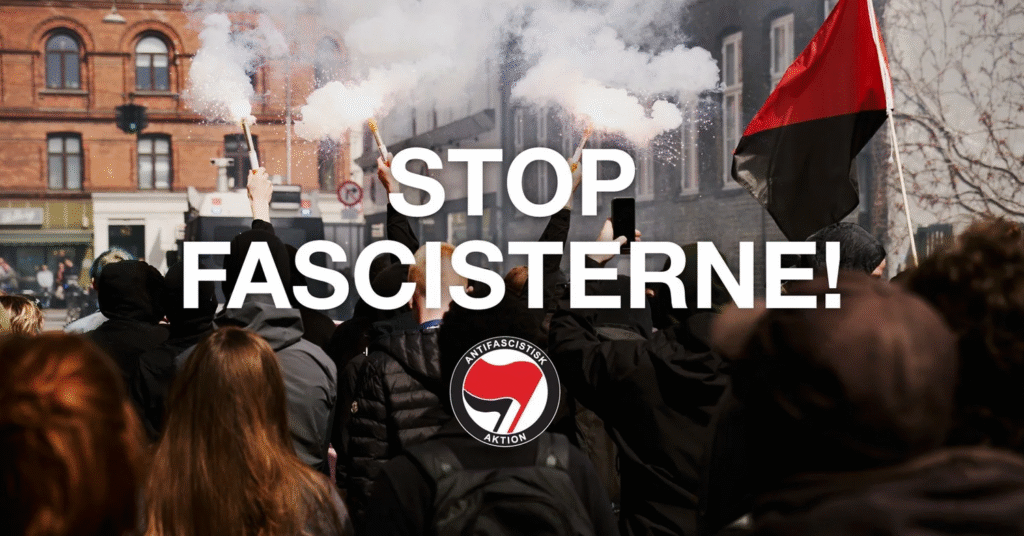
For example:
- Fascism = the political ideology or movement
- Fascist = a person who supports fascism
- Fascisterne = the fascists
- Fascistisk = fascist or fascistic, depending on context
The word can therefore appear in historical writing, political discussions, newspapers, books, documentaries, and discussions about European history.
Also read:Magazineluiza Com Br Email Format: A Complete Guide to Magazine Luiza Email Addresses
What Is Fascism?
Fascism is a far-right authoritarian political ideology and movement that developed in Europe during the early 20th century.
The United States Holocaust Memorial Museum describes fascism as an ultranationalist and authoritarian political philosophy that places the nation above the individual and rejects liberal democracy, pluralism, and political equality. Fascist movements also commonly emphasize militarism, political violence, centralized authority, and an idealized national community.
Fascism is not simply “strong government.”
A government can be strong while remaining democratic.
Fascism is better understood through a combination of ideas and political practices.
Common characteristics include:
- Extreme or exclusionary nationalism
- Authoritarian leadership
- Rejection of liberal democracy
- Hostility toward political opponents
- Glorification of national unity
- Acceptance or celebration of political violence
- Militarism
- Suppression of opposition
- Strong propaganda
- An emphasis on collective identity over individual rights
Not every authoritarian government is fascist, and not every nationalist movement is fascist.
This distinction matters.
Calling every political opponent “fascist” can make the word less useful. Historically, fascism refers to a specific family of political movements with identifiable characteristics.
Where Did Fascism Begin?
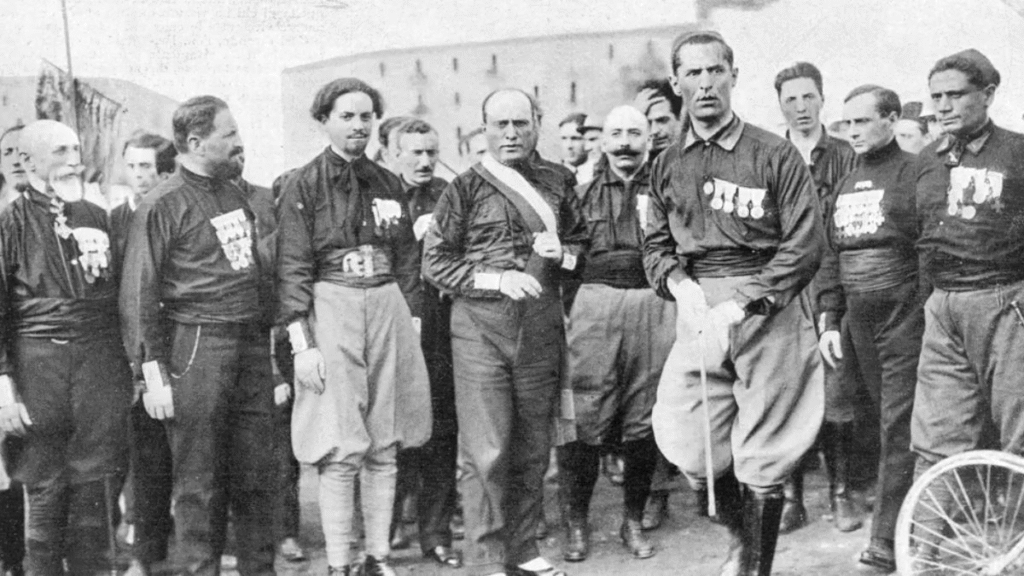
Modern fascism first developed in Italy after World War I.
Benito Mussolini played the central role in organizing Italian fascism. In 1919, he founded the movement that eventually became the National Fascist Party. In 1922, the March on Rome helped bring Mussolini to power.
Italy had experienced enormous social and political tension after World War I.
Many people were frustrated by:
- Economic problems
- Political conflict
- Fear of socialism and communism
- Social unrest
- National disappointment
- Weakness in existing political institutions
Fascist leaders used these fears to present themselves as defenders of national order.
The basic political message was powerful and simple.
The nation was supposedly in danger.
Traditional politics was supposedly failing.
A strong leader was supposedly needed.
Political opponents were presented as enemies of national unity.
These ideas helped fascist movements attract supporters.
Why Did Fascism Grow After World War I?
World War I changed Europe dramatically.
Millions of people had died.
Economies were damaged.
Empires collapsed.
Borders changed.
Political systems were unstable.
Social divisions became sharper.
This environment created opportunities for radical movements.
Fascist leaders did not invent every problem they discussed. Many societies genuinely faced serious economic and political difficulties.
The important point is how fascist movements interpreted those problems.
Instead of supporting pluralism and compromise, fascists often argued that national unity required obedience.
Instead of accepting political disagreement, they portrayed opponents as enemies.
Instead of trusting democratic institutions, they promoted authoritarian leadership.
This helped transform fear and frustration into political mobilization.
Fascism and Nationalism
Nationalism was central to fascist politics.
But fascist nationalism was generally more extreme than ordinary patriotism.
Patriotism can mean love for one’s country.
Fascist nationalism often went further by claiming that the nation must be politically, socially, and culturally unified.
People who were considered outsiders could be excluded from the national community.
The Holocaust Encyclopedia explains that fascist systems often define who belongs to the national community and who does not, with exclusion and repression becoming central political tools.
This is one reason fascism can become dangerous.
Once political leaders define some citizens as less legitimate members of the nation, discrimination can become easier to justify.
Fascism and Authoritarian Leadership
Fascist movements commonly promote a strong leader.
The leader is presented as someone who can supposedly express the true will of the nation.
This can weaken democratic institutions.
In a healthy democracy, political authority is divided among institutions.
There are elections.
There are courts.
There are legislatures.
There are opposition parties.
There are independent organizations and media.
Fascist systems reject many of these limitations.
The leader becomes more important than the institution.
Political loyalty becomes more important than disagreement.
That is one of the key differences between democratic nationalism and fascist politics.
Fascism and Political Violence
Violence played an important role in several historical fascist movements.
Fascist organizations often used paramilitary groups to intimidate political opponents and demonstrate strength.
The Holocaust Encyclopedia notes that fascism can embrace paramilitarism and treat violence as acceptable when it is presented as serving the national community.
This is not a minor feature.
Political violence can destroy democratic competition.
When people fear physical attacks, intimidation, or imprisonment, free political participation becomes difficult.
The result is a political environment where only one side can operate safely.
Fascism and Propaganda
Propaganda was another major part of fascist politics.
Fascist governments and movements used newspapers, posters, speeches, radio, public events, symbols, and later other forms of mass communication.
The purpose was not simply to inform.
Propaganda attempted to shape emotions.
It could create:
- Fear
- Anger
- Pride
- Loyalty
- Hatred
- Hope
- Suspicion
The message was often simplified.
A complicated political problem might be blamed on one enemy.
A national crisis might be blamed on a minority.
A political leader might be presented as the only person capable of saving the country.
This is one reason studying fascist propaganda is useful today. It shows how political communication can use emotion to replace careful discussion.
Fascism and the Idea of the Enemy
Fascist movements often define themselves partly through enemies.
These enemies can include political opponents, minorities, immigrants, communists, socialists, journalists, intellectuals, or other groups.
The exact targets varied between countries.
In Nazi Germany, antisemitism became a central part of the political worldview. The Nazi regime eventually used its racial ideology to justify systematic persecution and mass murder, including the Holocaust.
This history demonstrates the extreme consequences that can follow when political ideology combines authoritarianism, racism, dehumanization, and state power.
Fascism and Democracy
Fascism is fundamentally hostile to liberal democratic principles.
Democracy assumes that citizens can disagree.
Fascism tends to treat disagreement as a threat to unity.
Democracy accepts changes in government through elections.
Fascist systems seek concentrated power.
Democracy protects political pluralism.
Fascism seeks political unity under authoritarian leadership.
This does not mean every democratic government is perfect.
Democracies can experience corruption, inequality, political division, and institutional failure.
But their basic structure allows citizens to challenge leaders without requiring the destruction of the political system itself.
Fascism in Denmark
Denmark had fascist and Nazi movements during the interwar period, but they did not achieve the level of political power seen in Italy or Germany.
This is an important part of Danish history.
The political system in Denmark remained comparatively stable during the interwar period. According to Denmark’s historical research resources, authoritarian currents existed on the right and were influenced by fascism and Nazism, but the Danish Nazi movement remained marginal.
The most important Danish Nazi party was the Danmarks Nationalsocialistiske Arbejderparti, or DNSAP.
What Was DNSAP?
DNSAP was Denmark’s principal Nazi political party during the 1930s and World War II.
It was founded on November 16, 1930, by Cay Lembcke. In July 1933, Frits Clausen replaced Lembcke as party leader.
DNSAP was strongly inspired by Hitler’s NSDAP.
Its program and organizational structure closely followed the German model. Historical sources note that DNSAP copied much of the German party’s program, symbolism, leadership principle, antisemitism, nationalism, and opposition to parliamentary democracy.
This is why discussions of fascisterne in a Danish context often overlap with discussions of Danish Nazis.
The two concepts are related, although fascism and Nazism should not simply be treated as identical in every historical context.
The Early Danish Fascist Environment
DNSAP was not the only radical right-wing organization in Denmark.
During the interwar period, numerous small groups appeared.
Historical research indicates that around 29 parties or party-like groups associated with Danish Nazism existed between 1930 and 1945. Most were small and short-lived. DNSAP was the largest and most important of these organizations.
This fragmentation is important.
It shows that fascist and Nazi ideas did not automatically create one united political movement.
Leadership disputes, ideological disagreements, personalities, organizational problems, and limited public support weakened these groups.
Why Did Danish Fascism Remain Marginal?
There was no single reason.
Several factors likely mattered.
Denmark had established parliamentary institutions.
Political compromise was relatively strong.
The country had functioning political parties.
Economic and social problems did not automatically destroy democratic legitimacy.
And most Danish voters did not support Nazi politics.
DNSAP’s electoral performance demonstrates this clearly.
The party entered parliament in 1939 with three seats. Even at its best election result in 1943, it received only about 43,000 votes, which remained a major disappointment for the party.
This is a useful lesson.
Political extremism can be visible without being politically dominant.
A movement may have newspapers, uniforms, rallies, and committed members while still representing only a small part of the population.
Frits Clausen and DNSAP
Frits Clausen became the most important leader of DNSAP.
Under his leadership, the party remained committed to a Danish version of National Socialism strongly influenced by Germany.
The party promoted:
- Nationalism
- Antisemitism
- Antiparliamentarianism
- Authoritarian leadership
- Racial ideology
- A corporative political model
The party also adopted Nazi symbols and organizational methods from Germany.
Despite these efforts, DNSAP failed to become a mass electoral movement.
DNSAP During the German Occupation
Germany occupied Denmark on April 9, 1940.
The occupation dramatically changed the position of Danish Nazis.
DNSAP now existed in a country controlled by Nazi Germany.
This gave the party greater political importance than its prewar election results might suggest.
But the party still did not become the government of Denmark.
The Danish government continued to function under the occupation for a period through the policy commonly known as cooperation or collaboration policy.
Historical research emphasizes that this policy was complex. It was intended partly to limit German interference and keep Danish Nazi influence contained, even though it also involved cooperation with the occupying power.
This is an important distinction.
The existence of German occupation did not mean that every Danish political institution or citizen became a Nazi supporter.
Danish Nazis and the German War Effort
DNSAP became involved with German military recruitment during the occupation.
One major example was Frikorps Danmark, a Danish Waffen-SS volunteer unit created after Germany invaded the Soviet Union in June 1941.
DNSAP was involved in recruitment, and the Danish government publicly approved the appointment of C. P. Kryssing as commander in July 1941.
This demonstrates how Danish Nazi organizations became connected to the wider German war effort.
It also shows why the historical meaning of fascisterne cannot be separated from the occupation and World War II.
Danish Resistance to Fascism and Nazism
Not all Danes accepted Nazi politics.
Resistance developed in different forms.
Some people distributed illegal newspapers.
Others helped people escape.
Some participated in sabotage.
Others supported underground political organizations.
During the later occupation, resistance became increasingly important.
Also read:Quad Equalizer: Complete Guide to Four-Band EQ, How It Works, Uses, Settings, and Best Practices
Denmark’s historical record shows that resistance emerged from different political backgrounds, including communists and conservatives, and that these groups sometimes cooperated despite major ideological differences.
This is an important reminder that resistance to fascism was not limited to one political ideology.
People with very different political beliefs could oppose authoritarian occupation.
Danish Propaganda and Nazi Media
Propaganda was an important part of Danish Nazi politics.
DNSAP used newspapers and other media to spread its worldview.
One example was Nordjyden, a Danish Nazi newspaper published in 1937. It promoted party themes and included attacks against Jews and communists.
This illustrates how propaganda works at the local level.
A movement does not need to control an entire country to create propaganda.
It can use newspapers, meetings, posters, organizations, and community networks to spread its message.
The Role of Antisemitism
Antisemitism was central to Nazi ideology.
This was also true of DNSAP.
Historical documentation shows that Danish Nazi politics included antisemitic ideas alongside nationalism and opposition to parliamentary democracy.
Antisemitism was not simply one political opinion within Nazi ideology.
It was part of the wider racial worldview.
The Nazi idea of a supposedly pure national community depended on defining some people as outsiders.
In Germany, this eventually contributed to persecution, deportation, and genocide.
The Danish case developed under different circumstances, but the ideological connection to German Nazism remains historically significant.
What Happened to DNSAP After 1945?
The German occupation ended in May 1945.
DNSAP collapsed as a significant political organization.
The party formally ceased to exist in 1945.
The end of the war also created a major political and legal reckoning.
People associated with collaboration and Nazi activities faced different forms of consequences.
The postwar period included legal prosecutions and social punishment.
The country also had to confront difficult questions about responsibility.
Who had collaborated?
Who had resisted?
Who had joined Nazi organizations?
How should former members be treated?
These questions were not always easy to answer.
The Bovrup Archive
One of the most famous records of Danish Nazi membership is the Bovrup archive, often called Bovrupkartoteket.
It was based on membership records from DNSAP.
According to Lex, the records contain roughly 44,000 membership entries from 1930 to 1945. The archive was seized by the Danish resistance movement at liberation and is now held by the Danish National Archives.
The archive became controversial because it was used to identify people who had belonged to DNSAP.
In 1946, a portion of the information was published.
Historical sources explain that approximately 28,000 names were publicly released at that time.
The publication created significant social consequences.
Former party members could face dismissal, exclusion, or reputational damage.
The story demonstrates that political membership can have consequences long after a political movement has disappeared.
Why the Bovrup Records Still Matter
The archive is historically valuable because it provides evidence about the size and structure of Danish Nazism.
But it also raises questions about privacy, punishment, public memory, and historical responsibility.
There is a major difference between studying historical records and using them to harass living people.
Modern historical research should treat such material carefully.
A person’s appearance in a historical record does not automatically tell us everything about:
- Their motivation
- Their political activity
- Their level of commitment
- Their behavior during the occupation
- Whether they later changed their beliefs
Historical records require context.
Fascisterne and the Meaning of Political Labels
The word fascisterne can also appear in modern political debate.
People sometimes use “fascist” as a general insult for authoritarian, aggressive, or extreme political behavior.
This can create confusion.
A political disagreement does not automatically make someone a fascist.
Historically, fascism has a specific meaning.
The term becomes less useful if it is applied to every political movement that someone dislikes.
A better approach is to ask specific questions.
Does the movement reject democratic pluralism?
Does it support authoritarian leadership?
Does it glorify political violence?
Does it promote exclusionary ultranationalism?
Does it seek to suppress political opponents?
Does it organize society around a supposedly unified national community?
The more of these characteristics are present, the more useful the comparison with historical fascism becomes.
Fascism Versus Conservatism
Fascism should not be confused with ordinary conservatism.
Conservatism can support tradition, gradual change, social stability, and existing institutions.
Fascism historically sought much more radical political transformation.
Fascist movements could reject existing institutions and attempt to create a new authoritarian national order.
The two traditions therefore cannot simply be treated as identical.
Fascism Versus Nationalism
Nationalism is also broader than fascism.
A nationalist may believe that a nation should have political independence or that national culture should be protected.
Fascist nationalism is generally more authoritarian and exclusionary.
The difference lies partly in how national identity is understood.
Democratic nationalism can coexist with pluralism.
Fascist nationalism tends to demand political unity and can define minorities or opponents as threats.
Fascism Versus Nazism
Fascism and Nazism are closely related but not exactly interchangeable terms.
Italian Fascism developed under Mussolini.
German Nazism developed under Hitler.
Both rejected liberal democracy and promoted authoritarian nationalism.
But Nazism placed an especially central role on racial ideology and antisemitism.
The Nazi regime’s racial worldview became the basis for persecution and genocide.
In Danish history, DNSAP is usually described as a Nazi party because of its close connection to German National Socialism.
Fascisterne in the Modern World
Fascist and neo-fascist movements continued to exist after World War II.
They have appeared in different countries and under different names.
However, modern movements should be evaluated individually.
A movement does not become fascist simply because it is right-wing, nationalist, anti-immigration, authoritarian, or populist.
Historical analysis requires more than one political label.
Researchers examine ideology, organization, leadership, political goals, attitudes toward democracy, use of violence, and treatment of minorities.
Why Fascism Still Matters
Studying fascism is not only about learning old history.
It helps people understand how democratic systems can become vulnerable.
Fascist movements often gained support during periods of fear and uncertainty.
They promised simple answers to difficult problems.
They identified enemies.
They offered strong leadership.
They used emotionally powerful propaganda.
They claimed that national unity was more important than political disagreement.
These patterns are worth understanding because democratic institutions require active public participation.
Warning Signs in Political Movements
History does not provide a simple checklist that predicts every future authoritarian movement.
But several warning signs deserve attention.
These can include:
- Rejection of peaceful political competition
- Political violence
- Dehumanization of opponents
- Claims that only one leader represents the nation
- Attacks on independent institutions
- Suppression of the press
- Extreme exclusionary nationalism
- Conspiracy-based political messaging
- Efforts to eliminate political pluralism
One warning sign alone does not prove that a movement is fascist.
The broader pattern matters.
Why Democratic Institutions Matter
The Danish experience is especially useful because fascist and Nazi movements existed but did not achieve lasting control over the parliamentary system.
Denmark’s democratic institutions proved more resilient than those in some other European countries.
Historical research describes the interwar period as a time when parliamentary democracy became more firmly established even while criticism of democracy increased.
This shows that democracy is not simply the absence of extremists.
Democracy also depends on institutions that can withstand political pressure.
The Importance of Political Pluralism
Pluralism means that different political groups can exist peacefully.
People can support different parties.
They can disagree about economic policy.
They can disagree about religion.
They can disagree about foreign policy.
They can disagree about social issues.
A healthy democracy does not require everyone to agree.
Fascist politics tends to treat disagreement as a sign of disloyalty.
That is why political pluralism is one of the strongest protections against authoritarianism.
Fascisterne and Historical Memory
The history of fascisterne is also a story about memory.
Every generation must decide how to teach difficult history.
The goal should not be to make history comfortable.
It should be to make history understandable.
That means examining:
- How fascism developed
- Why people supported it
- How propaganda worked
- Why democratic institutions weakened in some countries
- How minorities were targeted
- How violence became normalized
- How resistance developed
- What happened after liberation
A simple story of “good people versus bad people” may feel satisfying, but it does not fully explain history.
Understanding why movements gain followers is more educational.
Why People Joined Fascist Movements
People did not all join fascist movements for identical reasons.
Some believed the ideology.
Some were motivated by nationalism.
Some feared communism.
Some wanted social order.
Some were attracted to strong leadership.
Some sought political influence.
Some joined because friends or family members were involved.
Others may have joined for practical reasons.
This does not excuse their actions.
It simply helps historians understand how political movements grow.
Understanding motivation is not the same as defending ideology.
The Human Cost of Fascism
The historical cost of fascism was enormous.
Under fascist and Nazi regimes, political opponents were imprisoned and persecuted.
Minorities were targeted.
Civil liberties were destroyed.
Wars caused massive destruction.
In Nazi-controlled Europe, systematic persecution developed into the Holocaust and other mass crimes.
This is why fascism should be studied not only as a political theory but also as a historical system with real human consequences.
Behind political terminology were millions of individual lives.
Lessons From Danish History
The Danish experience offers several useful lessons.
First, extremist movements can exist without becoming majority movements.
Second, democratic institutions can limit radical political groups.
Third, foreign occupation can dramatically change domestic political conditions.
Fourth, propaganda can influence political culture even when a movement fails electorally.
Fifth, collaboration and resistance can involve complicated choices.
Sixth, the consequences of political extremism can continue long after a war ends.
These lessons make Danish history relevant beyond Denmark.
Fascisterne: A Simple Summary
The easiest way to understand the topic is through the following structure:
| Term | Meaning |
| Fascism | An authoritarian, ultranationalist political ideology and movement |
| Fascist | A person associated with or supporting fascism |
| Fascisterne | Danish for “the fascists” |
| Nazism | German National Socialism, closely related to fascism but with its own specific racial ideology |
| DNSAP | Denmark’s main Nazi party from 1930 to 1945 |
| Frits Clausen | Major leader of DNSAP |
| German occupation | Nazi Germany’s occupation of Denmark from 1940 to 1945 |
| Bovrupkartoteket | Historical DNSAP membership records |
Final Thoughts
Fascisterne is a simple Danish word, but it opens the door to a much larger historical subject.
The word means “the fascists,” while fascism describes the ideology and political movement associated with authoritarian nationalism, rejection of liberal democracy, political violence, centralized leadership, and exclusionary ideas about national identity.
In Denmark, the history of fascisterne is closely connected with the rise of Danish Nazism during the 1930s, particularly through DNSAP. The party was founded in 1930 and closely copied important elements of Hitler’s German Nazi Party. Despite its efforts, it remained politically marginal and never achieved the level of power that Nazi movements achieved in Germany.
The German occupation of Denmark changed the situation. Danish Nazis became connected with the occupying power and participated in activities such as recruitment for Frikorps Danmark. At the same time, resistance movements developed across different parts of Danish society.
After liberation in 1945, DNSAP disappeared and the country faced the difficult task of dealing with collaboration and political responsibility. Records such as the Bovrupkartoteket became important parts of that history.
The most important lesson is that fascism should be understood through evidence and historical context rather than used as a simple political insult. Fascisterne were not simply people who supported a strong government. Historically, fascist movements sought a political order based on authoritarian leadership, national unity, suppression of opposition, and rejection of democratic pluralism.
Studying this history helps explain why democratic institutions, independent media, political pluralism, civil rights, and respect for minorities matter. It also reminds us that political movements can grow during periods of fear and uncertainty, and that the language used to describe enemies can have serious consequences.
Understanding fascisterne is therefore not only about translating a Danish word. It is about understanding one of the most important political movements in modern European history and the human consequences that followed when authoritarian ideology gained political power.
Frequently Asked Questions About Fascisterne
What does fascisterne mean?
Fascisterne is a Danish word meaning “the fascists.”
Is fascisterne an ideology?
No. It refers to people associated with fascism.
What is fascism?
Fascism is an authoritarian and ultranationalist political ideology that rejects liberal democratic pluralism.
Is fascism the same as Nazism?
They are closely related, but Nazism has its own specific racial and antisemitic ideology.
What was DNSAP?
DNSAP was Denmark’s main Nazi political party from 1930 to 1945.
Who led DNSAP?
Frits Clausen became the party’s leader in 1933 after Cay Lembcke.